MLA Texts and Translations
There are 80 products in MLA Texts and Translations

Popular Literature from Nineteenth-Century France: English Translation
The city of Paris experienced rapid transformation in the middle of the nineteenth century: the population grew, industry and commerce increased, and barriers between social classes diminished. Innovations in printing and distribution gave rise to new mass-market genres: literary guidebooks known as tableaux de Paris and illustrated physiologies examined urban social types and fashions for a broad audience of Parisians hungry to explore and understand their changing society. The works in this volume offer a lively, humorous tour of the manners and characters of the flâneur (a leisurely wanderer), the grisette (a young working-class woman), the gamin (a street urchin), and more. While authors such as Paul de Kock are little known today, their works still open a window onto a vivid time and place.
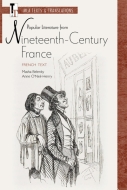
Popular Literature from Nineteenth-Century France: French Text
The city of Paris experienced rapid transformation in the middle of the nineteenth century: the population grew, industry and commerce increased, and barriers between social classes diminished. Innovations in printing and distribution gave rise to new mass-market genres: literary guidebooks known as tableaux de Paris and illustrated physiologies examined urban social types and fashions for a broad audience of Parisians hungry to explore and understand their changing society. The works in this volume offer a lively, humorous tour of the manners and characters of the flâneur (a leisurely wanderer), the grisette (a young working-class woman), the gamin (a street urchin), and more. While authors such as Paul de Kock are little known today, their works still open a window onto a vivid time and place.
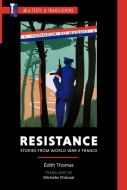
Resistance: Stories from World War II France
Based on real events of the French Resistance during World War II, Édith Thomas’s stories explore how ordinary people respond to the extraordinary conditions of political occupation. The stories, first published under the title Contes d’Auxois (Auxois Stories) by an underground press in 1943, were written to oppose Vichy-Nazi propaganda and to offer encouragement to civilians who felt resigned to defeat.
Whether lining up to wait for food, tuning in to a forbidden radio broadcast, adapting to living side by side with German soldiers, or preparing for an act of sabotage, the characters in these stories must make choices in highly compromised circumstances on a daily basis. As the characters confront their own suffering and that of others, their actions inspire readers to consider the nature of heroism, the idea that people can share a common humanity with their enemies, and the possibility for individuals to find solidarity in an overwhelming, isolating world.
Résistance: Contes de la Seconde Guerre mondiale en France
Based on real events of the French Resistance during World War II, Édith Thomas’s stories explore how ordinary people respond to the extraordinary conditions of political occupation. The stories, first published under the title Contes d’Auxois by an underground press in 1943, were written to oppose Vichy-Nazi propaganda and to offer encouragement to civilians who felt resigned to defeat.
Whether lining up to wait for food, tuning in to a forbidden radio broadcast, adapting to living side by side with German soldiers, or preparing for an act of sabotage, the characters in these stories must make choices in highly compromised circumstances on a daily basis. As the characters confront their own suffering and that of others, their actions inspire readers to consider the nature of heroism, the idea that people can share a common humanity with their enemies, and the possibility for individuals to find solidarity in an overwhelming, isolating world.
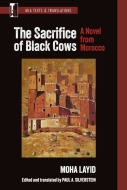
The Sacrifice of Black Cows
An oasis community in Morocco hopes to stop a devastating drought by sacrificing black cows to satisfy the spirits. But the wise elder Bassou secretly plans a different solution: to sabotage the motorized pumps that have lowered the water table and nearly destroyed the subsistence farming and herding that support the local way of life. The young newlywed Yidir agrees to help him and eventually becomes a part of the broader fight for Moroccan independence from French colonial rule.
Portraying an indigenous community undergoing radical change, The Sacrifice of Black Cows reflects on notions of modernity and tradition, science and spirituality, free will and fate, and considers the moral obligations of individuals and community. First published in French in 1992, the novel received international acclaim and is regarded as the single best work about Amazigh culture in southeastern Morocco. It was adapted into the award-winning film Atash (Thirst) by the Moroccan director Saâd Chraïbi in 2000. Here, it is presented in a riveting new translation by Paul A. Silverstein.
Le sacrifice des vaches noires
An oasis community in Morocco hopes to stop a devastating drought by sacrificing black cows to satisfy the spirits. But the wise elder Bassou secretly plans a different solution: to sabotage the motorized pumps that have lowered the water table and nearly destroyed the subsistence farming and herding that support the local way of life. The young newlywed Yidir agrees to help him and eventually becomes a part of the broader fight for Moroccan independence from French colonial rule.
Portraying an indigenous community undergoing radical change, Le sacrifice de vaches noires reflects on notions of modernity and tradition, science and spirituality, free will and fate, and considers the moral obligations of individuals and community. First published in French in 1992, the novel received international acclaim and is regarded as the single best work about Amazigh culture in southeastern Morocco. It was adapted into the award-winning film Atash (Thirst) by the Moroccan director Saâd Chraïbi in 2000.
Sarah: An English Translation
A dugout canoe comes ashore on the island of Saint-Barthélemy in the Antilles; in it are a black man, Arsène, and a sleeping white child, Sarah. Seeking refuge, they are taken in by a good man, but the overseer of his plantation threatens both Arsène and Sarah with the loss of their freedom.
Deborah Jenson and Doris Kadish introduce Sarah, an 1821 novella by Desbordes-Valmore, explaining its autobiographical background, political context (the revolt of blacks against Napoléon’s soldiers), and literary genre (sentimentalism). The novella was a precursor to anticolonial and antislavery texts by Claire de Duras, Victor Hugo, George Sand, and Alphonse de Lamartine.
Marceline Desbordes-Valmore (1786–1859), born in an artisan’s family, was poor much of her life. Her arrival with her mother in the French Caribbean coincided with the outbreak of rebellion among the black population. After her mother’s death, Desbordes-Valmore returned to Europe, where she worked as an actress and eventually made her name as a Romantic poet.

Sarah: The Original French Text
A dugout canoe comes ashore on the island of Saint-Barthélemy in the Antilles; in it are a black man, Arsène, and a sleeping white child, Sarah. Seeking refuge, they are taken in by a good man, but the overseer of his plantation threatens both Arsène and Sarah with the loss of their freedom.
Deborah Jenson and Doris Kadish introduce Sarah, an 1821 novella by Desbordes-Valmore, explaining its autobiographical background, political context (the revolt of blacks against Napoléon’s soldiers), and literary genre (sentimentalism). The novella was a precursor to anticolonial and antislavery texts by Claire de Duras, Victor Hugo, George Sand, and Alphonse de Lamartine.
Marceline Desbordes-Valmore (1786–1859), born in an artisan’s family, was poor much of her life. Her arrival with her mother in the French Caribbean coincided with the outbreak of rebellion among the black population. After her mother’s death, Desbordes-Valmore returned to Europe, where she worked as an actress and eventually made her name as a Romantic poet.

Selected Poetry and Prose of Évariste Parny: In English Translation, with French Text
Praised by Voltaire and admired by Pushkin, Évariste Parny (1753–1814) was born on the island of Reunion, which is east of Madagascar, and educated in France. His life as a soldier and government administrator allowed him to travel to Brazil, Africa, and India. Though from the periphery of France’s colonial empire, he ultimately became a member of the Académie Française. Despite his reaching that pinnacle of respectability, some of his poetry was banned after his death.
This edition includes poems from the Poésies érotiques and Élégies, which established Parny’s reputation; the Chansons madécasses (“Madagascar Songs”), which were influential in the development of the prose poem; five of his published letters, written in a mixture of prose and verse; the narrative poem Le voyage de Céline; and selections from his sardonic, anticlerical later poetry. A substantial introduction discusses Parny’s poetry in connection with its literary context and the themes of gender, race, and postcoloniality.
“The Signorina” and Other Stories
Greatly influenced by writers ranging from Dickens and Proust to Woolf and Colette, Anna Banti was a prominent figure on the Italian literary scene from the 1940s until her death in 1985. The five tales in “The Signorina” and Other Stories display her talent across many genres—fiction, science fiction, historical fiction, mystery.
Banti’s stories portray the ageless conflict between the expectations of society and the aspirations of the individual. In “Uncertain Vocations,” the young Ofelia becomes a pianist after her marriage prospects fail, but self-doubt turns her success into miserable mediocrity. In the futuristic “The Women Are Dying,” men acquire a new evolutionary ability; women, lacking that ability, are consigned to the status of an inferior race. “Joveta of Betania,” set in the time of the Crusades, follows the daughter of King Baldwin II of Jerusalem as she escapes to a life of seclusion as an abbess—a life that becomes for her a source of proud freedom and deep bitterness. In “Sailing Ships,” a young boy creates an imaginary world from an uncertain childhood memory. “The Signorina” tells of a young woman who eventually finds herself, as a writer.
