2018 Presidential Address: ¡Presente!
The Presidential Address was delivered at the 2018 MLA Annual Convention in New York City by Diana Taylor, then president of the association. An audio recording and the text of her speech, which was introduced by Executive Director Paula M. Krebs, appear here. The address also appears in the May 2018 issue of PMLA.
. . . jaqxam sar . . .
—Silvia Rivera Cusicanqui
. . . to be me, I have to walk and talk with others . . .1
A Foray into ¡Presente!
On 28 August 1968, at the height of the explosive student protests in Mexico, government officials forced civil servants to “hacer presencia” (literally “make presence”) in the massive Zócalo (Mexico City’s central square in front of the National Palace, built literally on top of the ruins of the conquered Aztec empire). This counterprotest, choreographed by the government, was a response to the takeover of the Zócalo a day earlier by hundreds of thousands of students who had raised a black-and-red strike flag on the central flagpole and made a series of demands: the release of their fellow protesters from jail, an end to police violence, and a face-to-face meeting with President Díaz Ordaz. The president refused, staging instead a performance of party loyalty labeled a “ceremonia de desagravio” (“act of redress”). The enormous Mexican flag waved once again from the flagpole in the middle of the square. The thousands of workers who attended this oversize show of national unity and purpose faced the speaker. All at once, without apparent prompting or preparation, they turned around and started bleating like sheep and yelling: “Somos borregos! Nos llevan! Bee! Bee!” (“We’re sheep! They’re herding us! Baa! Baa!” [Monsiváis; see also Poniatowska; Taibo]).
The civil servants are present, but they present themselves as sheep, not as subjects but as subjugated political animals. They perform their agency by becoming nonagents. Yet they, not the government, remind us that they control their representation. They refuse to play the game, to pretend to be loyal workers in the fake revolutionary party that is the PRI—the oxymoronically named Institutional Revolutionary Party that ruled Mexico from 1929 to 2000 and is in power again now. Their “baaa” attests to the degraded condition, even ontological deformation, of workers in the country’s crony capitalist economy of the 1960s. They are ¡presente! in their refusal. They turn their back on the state’s representation of itself as a thriving democracy of free subjects and re-present themselves as absurd figures in a ridiculous sham government. The workers seemingly enter into what Hannah Arendt calls the “space of appearance”: “the organization of the people as it arises out of acting and speaking together . . . [whose] true space lies between people living together for this purpose” (178). The government assumes it controls the space of appearance, demanding a show of loyalty from its vulnerable subjects. But with one turn of the collected bodies, one unified “baaa,” one ¡presente!, they call into question the space of appearance itself. Who can appear and how? In this simulated space of political representation, the workers can appear not as a “who,” a “somebody [with] qualities, talents,” but as a “what” (179). A new political subjectivity, a contingent “we” (“we’re sheep”), emerges through this act of subverting the state’s staged image of collective purpose.2 This simple act of defiance, the spontaneous and unpremeditated bleating at and turning one’s back on authority, illuminates much of what I want to get at in the term ¡presente!. The meaning of ¡presente!, with and without exclamation points, depends on context. As much an act as a word, ¡presente! can be understood as a war cry in the face of nullification; an act of solidarity or standing with; a commitment to witnessing; a joyous accompaniment; present among, with, and to; walking and talking with others; an ontological and epistemic reflection on presence and subjectivity as participatory and relational, founded on mutual recognition; a showing or display before others; a militant declaration of presence; the “ethical imperative,” as Gayatri Chakravorty Spivak calls it, to stand up to and speak against injustice (440); and, of course, defiance of authority, exemplified by the workers-as-sheep event described above.
But why ¡presente!? For one thing, no word in English captures the force or multivalence of this term. The gesture of the raised fist enacts the militancy of the term. The sense of “we’re here, we’re queer, get used to it” reflects the defiance. Shared moments of silence accompany it. “Say her name” conveys its recuperative gesture. Singing and dancing in a rally capture its joyful, animating quality. Yet it’s important to cluster these many meanings in a term and think them through together in this word-act. ¡Presente! allows for that kind of capacious thinking, its several meanings reminding us that no one aspect of it is enough to produce change; refusal is not enough, defiance is not enough, and joy—alas—is not enough. Coming into presence, into ¡presente!, means becoming a “who” to one another, especially in spaces that withhold recognition, withhold appearance. Political interventions require a complex play of dispositions, moves, and gestures.
So back to the sheep. The government’s command that the civil servants be present, that they make presence, clearly exemplifies Louis Althusser’s hail, the “hey there” of those in authority that interpellates their addressees as state subjects. Yet the event also affirms that what Félix Guattari calls “subjective pluralism” and the “group subject” is both singular and plural (“Place” 152). The term “collective,” referring not just to a bunch of sheep that supposedly are easily led, “should be understood in the sense of a multiplicity that deploys itself” (Chaosmosis 9; my italics). Much like the civil servants, whose rebuff gives a meaning to the term collective different from the one the government had in mind, the collective is both singular and multiple, both the object of the government’s performative utterance and the subject of the act of refusal. The performative, as a specific category of action, is successful, J. L. Austin argued, when certain circumstances or conventions are in place (8). Words then can act, do something, or make something happen (12). Those in authority—the priest, or judge, or official—utter the words. Those in attendance—at the wedding, in the courtroom—follow conventions and validate the proceedings. The structuring of the act of redress in front of the Zócalo certainly set up the circumstances for the performative to succeed. Look at them all, present by our orders. On this performance, however, rests the legitimacy of the state itself.
Performatives are not “true” or “false,” Austin notes, but rather “happy” (successful) or “unhappy” (unsuccessful), depending on the “uptake” (54). Andrew Parker and Eve Kosofsky Sedgwick note that the performative “invokes the presumption, but only the presumption of a consensus between speaker and witnesses.” The civil servants refuse to perform the consensus that the state demands. Parker and Sedgwick might call this act of refusal a “negative performative” insofar as it signals a “disavowal, renunciation, repudiation, ‘count me out’” (9).
To refer to the civil servants’ rebuff to the performative, however, I use the term animative to name the unspoken resistance that exists as and through enacted refusal. Athletes take a knee during the national anthem. The teacher speaks; the student looks out the window or talks to a neighbor. Not present, really, but not not present. Not a performative, but not a negative performative. This kind of refusal is not a “you’re fired” back to power, which arguably qualifies as a negative performative, but a gesture that interrupts the conventions on which the performative relies.
Animatives, as I define them, are embodied, communicative acts that refuse the performative utterance that tries to interpellate and frame them. Animatives, thus, are necessarily relational and responsive. Taking a knee and looking out the window only enact refusal within their specific contexts. Their efficacy relies on the extent to which they can deflect or derail the performative utterance through emotional and affective body-to-body transmission. Animatives are part movement, as in animation, part identity, being, soul, or life, as in the Latin anima. The term captures the fundamental movement that enlivens embodied practice and emotion. The Spanish animo (“cheer up”) emphasizes another set of meanings, this time from the Latin animatus: courage, resolve, and perseverance. It enacts dispositions: fears, hopes, outrage, and, of course, animus and animosity. Thus, animatives are fundamental to political life. As Manuel Castells reminds us, “emotions are the drivers of collective action” (134).
If performatives require certain conventions to be in place for their efficacy, animatives defy those specific conventions taking place in the messy, sometimes ugly, and often unstructured and unconventional gatherings of those who refuse interpellation. The white nationalists and neo-Nazis carrying tiki torches in Charlottesville defied certain conventions—those of liberty, equality, and justice—that underwrite democracy and animated others based on their exaltation of the white male body and their evocation of the Nuremberg rallies and KKK marches. Animatives thus encompass boisterous, contradictory, hostile, and vexed behaviors, experiences, and relationships. They exist in the realm of the potentially chaotic, liberatory, fascist, anarchist, and revolutionary. Political animatives (faith-based, hate-based, evidence-based, and other kinds) flourish on all sides of ideological divides.
Performatives, in the Austinean understanding of the term, function only within clearly demarcated conditions and, thus, always rely on authority and consensus for their success. Yet, for that reason, the threat of disruption always hovers over them. One of the many things I love about Austin’s writing on performatives is his elaboration of the ways they can go wrong. The swearing of the oath of office in January 2017 could function as a primer of the misfires, misinvocations, misapplications, infelicities, and unhappiness that Austin identifies in his “unhappy performatives” and that are intensifying our current #States of Insecurity, the presidential theme of the 2018 MLA convention. The performative was not false—the oath was taken—but the utterance-act “was void, or given in bad faith” (11). Not everyone was following the same playbook. Examples of performatives that fail can reveal strategies of resistance against the conventions and codes within which performatives attempt to claim enunciatory power.3
While animatives are one example of acts that can disrupt a performative, the theatrical aside counts as another, as does the idea of “obedezco pero no cumplo” (“I obey, but I won’t follow through”) and Michel de Certeau’s foot-dragging or “la perruque” (24–26). Relajo in Mexico and other words such as choteo in the Spanish-speaking Caribbean name acts of spontaneous disruption that defy authority, that rupture (even for a moment) the configuration and limits of a certain group or community.
Performatives and animatives only ever work together. Performatives may be aspirational and generative though not necessarily successful. Demanding “freedom” or “justice for all” does not bring them into existence. The words need to be acted on with the acknowledgment and agreement of those in attendance—whether the act is a wedding ceremony or a swearing in. Benjamin Arditi argues that protests themselves enact “the promise of something other to come.” The enactment, the uptake, the consent of those involved, however, are needed to complete the act. The performance, the as if, opens a space toward something (justice for all) that has not yet arrived and that might never be achieved. Political as ifs express the desire and demand for change; they leave traces that reanimate future scenarios. In Mexico, this means imagining the political as an arena of convergence, contestation, and potentiality rather than (as we know it to be) a done deal, brokered behind closed doors by those in control. The as ifs and what ifs, often dismissed as posturing or “only pretending,” can open liberating and progressive pathways to social reinventions, expanding the limits of the political imagination. The pushback might come in the form of other performatives (arresting the protestors) or animatives (fistfights on the ground). But these aspirational utterances do not constitute successful performatives. In fact, the reiterative calls for justice or the invocation of freedom might at times be lip service instead of meaningful action.
The reason for teasing out the ways in which these various acts work is not to cement distinctions but rather (in the spirit of Austin) to expand the range of political possibilities and methodologies within the broader rubric of performance. I use these terms, then, not to privilege binary understandings of political dynamics, such as high/low, bad/good, efficacious/failed, populist/elitist, or real/pretend. It is urgent to remember that performance is always unstable. All the more reason to understand the degree to which various forms of presence (including performatives and animatives) can disturb and upend political hierarchies and structures, and their legitimating discourses, by interruptions enacted from and on the ground.
Word of the civil servants’ defiance electrified the Zócalo. Students trying to push their way into the space felt the excitement on the outer edges. Bodies of all kinds, including the human body, make their own claims in ways that cannot be adequately understood by looking primarily at language. Political bodies are amplified and expanded by the mission, emotions, and hopes that animate them. As bodies, we are networked—connected, extended into the surrounding environment. Wired through neurological and hormonal pathways, our bodies sense and communicate the frustrations in and around us. Standing close together, people’s unrest becomes palpable. One person bleats, others follow. Politics takes place in the space between us, the productive gap across which we recognize each other.
Political subjectivity and space undergo change and mutually produce each other. As the students jostled one another marching down streets, they knew they were protagonists in a historic struggle for social justice. Denied a face-to-face dialogue with the president and shut out of the Zócalo, they demanded a space of recognition. The crowded space around the Zócalo became once again the scene of political reimaging, though, as Rebecca Schneider cautions, it is necessary to “both question and critique, deploy and resist . . . the norms of appearance that make a space ‘public.’” The space forced three to four hundred thousand people to communicate, protect, and rely on one another. These bodies, ignored by the corporate media, served as their own form of mediation. They performed their own outrage and desires.
Animatives often terrify governments whose main goal is to control bodies through the mobilization or threat of force, or through the use of performative edicts, decrees, and official utterances with the force of law. Bodies and embodied actions prove less containable than discursive practice does. They also challenge onlookers to interrogate spectacles of defiance and resistance. Who participates in the action? Who controls it? For better and for worse, animatives lack the legitimating structures, authority, and hierarchies that empower performatives. Animatives—linguistically so close to animation, to what Sianne Ngai calls the “non-stop technology” of cartoons—also raise serious questions of agency. “Animatedness,” she cautions, is “unusually receptive to outside control” (91). The inanimate body usurps the “human speaker’s voice” and agency (123). The ruckus may well be joyous and liberating, but it’s not always clear who controls it and what it’s really about.
The command performance of civil obedience turned out badly for the government. The act of redress backfired and went down, in Austinean terms, as an unhappy performative. The failure or infelicity of the act, however, had grave political consequences for the students and for the country as well: the gates of the presidential palace opened and tanks charged at the bodies in the square.
On 2 October 1968, less than five weeks after the workers-as-sheep event, several hundred students involved in the protests were massacred in the Plaza of Tlatelolco, a housing complex adjacent to the Zócalo. Their bodies were incinerated and disappeared. No one knows exactly how many were killed that night. The time for pretending that Mexico was a democracy that offered a space for political antagonism, pluralism, conflict, and negotiation was over. Mexico became a space of disappearance.
Why such a violent response from the government? The 1968 Olympics, scheduled to take place in Mexico City, were less than two weeks off. The unrest in the country made the organizers queasy. The protests had to stop. The games must go on. Sport stadiums had been built, airline tickets bought, hotels reserved, and athletes had trained for the high altitude. When Tommie Smith and John Carlos raised their fists on the podium to protest the treatment of black Americans, their defiant gesture linked the protest inside the stadium to the one outside. Even though the international news largely ignored the massacre and no one speculated that the causes of oppression were related, the acts of refusal called attention to the many who were willing to turn their backs or bleat or raise their fists in the face of violent authority.
Erica Chenoweth and Maria J. Stephan, authors of Why Civil Resistance Works, would classify the 1968 student movement as a failure because it did not achieve its stated goals (5). And yet there is an enormous amount to be learned from “unhappiness.” Faced with the Mexican state—quite literally a state of insecurity—that brutally curtailed the rights of its citizens, the students had led a powerful, nonviolent resistance movement. They succeeded in activating a broad sector of the population—including professors, teachers, artists, and, as we saw, Mexico’s civil servants—in support of social justice. Even the church bells of the National Cathedral in the Zócalo pealed in support of their aims. They were clear in their goals and maintained the moral high ground. Nonetheless, faced with a murderous, repressive military force, the movement crashed, and supporters returned to their political subjugation. The country went quiet; all dissent ceased. Mexico’s “Dirty War,” backed by the United States, continued to disappear dissidents and silence journalists throughout the 1970s and, one could argue, into the present.
What would efficacy or happiness mean for social movements, faced with brutal states that create insecurity? If we define success only in terms of achieving specific goals, then we inevitably fail. While the students “failed” to achieve their stated goals, their relentless activism brought alternative, more-democratic power structures into focus and into the discursive and performative political realm. Their movement moreover made visible the failure of the state, rendered illegitimate through its criminal abuse of power. The ’68 massacre lives. It has shaped the Mexican social and political imaginary. Still today, every 2 October people throughout Mexico hold events to honor and accompany the students, who are always ¡presente!. “El dos de octubre no se olvida” (“We do not forget 2 October”).
How and when do we begin to fully experience states of insecurity? During the MLA convention, many of us will explore the multiple dimensions of the political, economic, educational, and ideological turmoil of our times. For me, going back to 1968 is like revisiting the ur-moment in Mexico when everything changed for those of us who had not really understood that the government would kill students en masse and in full public view rather than negotiate a more open public sphere. I was finishing high school in a British school in Mexico City, still following the path of domestication and discipline that my parents had chosen for me as a young child in Parral, Chihuahua. I was still wearing the outfit—the blazer, tie, pleated skirt, and Oxford shoes—that recalled my boarding school years in Canada. While I had friends in the movement, the private school isolated me somewhat from the violence erupting in the city. In school, I remember, we’d debate whether Mexico would become a more egalitarian, democratic country, like the United States, maybe, where those in power were not corrupt and actually obeyed the law. No one mentioned the war in Vietnam or the systemic violence in the United States against Native, black, and Latinx Americans and other marginalized populations.
When I heard about the sheep event, then, I never forgot it. It immediately struck me as an act of genius. It reaffirmed my own attitude toward authority, which I manifested by jumping over the school fence after roll call whenever possible and walking home. ¡Presente!. But not really. This partial compliance exemplifies one of my favorite Mexican expressions and worldviews, “Sí, pero no.” Democracy? Here? There? Where? Yes, well, maybe no?
The Sheep, Again
Thirty years after the massacre of the students, the Belgian-Mexican artist Francis Alÿs staged a video performance, based on the defiance of the bureaucrats, called “La multiplicación de los borregos” (“The Multiplication of Sheep”).4 He walks around the same flagpole in the Zócalo, the one with the massive, undulating Mexican flag, leading a sheep on a leash. One by one, other sheep—not on leashes—join the circle, adapting their pace to keep equidistant from each other and maintain the circular formation (fig. 1). The bells of the cathedral ring incessantly, reminiscent of the same bells that pealed nonstop in support of the students back in 1968.5 Methodically, Alÿs continues to walk clockwise around the pole. Soon, twenty-one sheep have joined the walk. Magically, it seems, they follow each other in perfect formation. Then Alÿs drops the leash of the first sheep and it walks away from the circle in an orderly fashion. After every rotation, the next sheep peels off. At the beginning of the performance, each new sheep had joined the end of the line. Now, at the end, the sheep that leave the circle are the ones at the head of the line, those walking right behind Alÿs. He does not signal to them in any way. They just seem to know when it’s their turn. The distance grows between Alÿs and the sheep. Before long, Alÿs walks at the end of the line, following them. Who leads whom? Where do they go? The performance, as shown in the video on the artist’s Web site, lasts a little over twenty-five minutes.
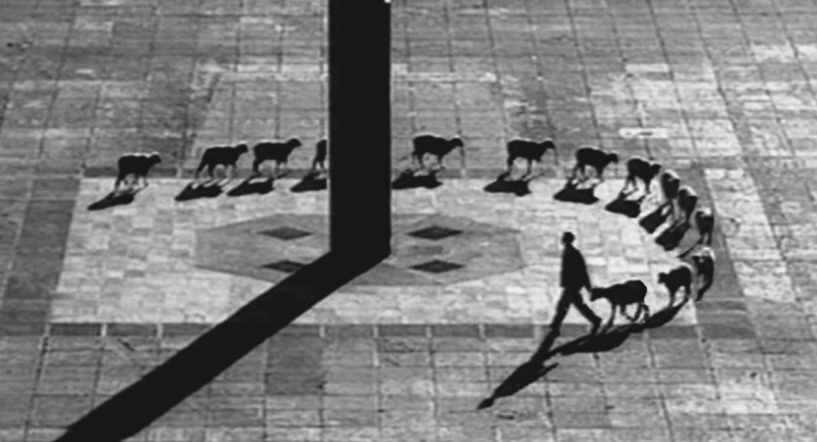
The performance space, also a political space, in 1968 as in 1998 is the arena of potentiality, recalling past hopes and past actions and hinting at other, perhaps better, futures. The curator Natasha Marie Llorens writes:
Alÿs brings the memory of humans acting like sheep together with the spectacle of sheep re-enacting human protest, demonstrating that how bodies appear in public is as important as the fact that they gather. And it is their gathering that produces the space of protest, of politics. Protest—a set of relations between people—thus produces the square anew in each instance.(9)
But Alÿs does more. His sheep indicate that protestors will not appear as people, as “men,” in Arendt’s words, “who show who they are, reveal actively their unique personal identities and thus make their appearance in the human world” (179). No, those in power will withhold recognition from those who refuse official interpellation. Denied subjectivity, protestors (like migrants, like slaves) need to fight precisely for how their bodies appear in public. The space of appearance then, as Judith Butler points out, is not a material given but itself what people seek to control: “It is not only that we need to live in order to act, but that we have to act, and act politically, in order to secure the conditions of existence” (58). ¡Presente! signals the determination to appear otherwise.
On 26 September 2014, indigenous and mestizo male students from the Ayotzinapa rural college commandeered five buses to take them to Mexico City for the 2 October commemoration of the massacred students. They did that every year and always brought the buses back. That night, a mix of local, military, and federal police joined with members of drug cartels to kill six people outright, including some students. They kidnapped and tortured dozens of other students and permanently disappeared an additional forty-three of them. State violence against students continues, unabated. Now, back in the Zócalo, we recite their names and say, yet again, ¡Presente!. The number forty-three and the phrase “el dos de octubre no se olvida” resonate throughout Mexico. ¡Presente! signals the now, again and seemingly always, of political violence. It has an enduring quality that invokes the dead that don’t die, the past that remains. Once we recognize how presence is shaped, contested, destroyed, performed, and reperformed, we can never not see it again. Each return to the Zócalo reminds us of the unhappy performatives, the powerful animatives, the ethical imperative to witness and accompany, and the refusal to legitimate acts of brutality. Each repeat performance accumulates affective, symbolic, and explanatory power.
Each repeat, however, involves difference. This time ¡presente! took on a decidedly militant attitude. The massive resistance to the state’s criminal politics threatened to overturn the government. Hundreds of thousands of protesters took to the streets, igniting once again the space of appearance, insisting on the centrality of the disappeared. Memes flooded public spaces throughout the country: #NosFaltan43 (“We are missing 43”) and #FueelEstado (“The State Did It”) among others. The former president Vicente Fox had words of advice for the families of the forty-three disappeared students, and for the rest of the population: “Get over it” (qtd. in Noel). State violence continues, and so does the opposition of those who choose every single day—sometimes against all odds—not to side with injustice. It’s not over; it’s never over. Here rests the force of the performance of resistance that can stand up to the performative command to move on. Performance, as Richard Schechner defines it, is “never for the first time” (36). The repeats take on a life and animate the political: making presence, making memory, making space for alternative visions of livable lives. An anti-imperial, antinationalist, post-Cartesian, and even posthuman “we” is shaped through these performances. The “we” acts, both product and agent of the negotiation of political life. Who leads whom? We continue to crash the space of appearance, producing it again, and always, anew.
Notes
1. All translations from the Spanish are mine unless otherwise noted.
2. A similar act, with a different political valence, occurred in 2014 when New York City police officers turned their backs on the large screen showing Mayor Bill de Blasio as he spoke at a funeral for slain officers (Schabner). The police snubbed de Blasio for accepting the legitimate claim by Black Lives Matter activists that the police killings of unarmed African Americans had to stop (Fermino).
3. Artistic and activist practices often disrupt performatives. Las Yeguas del Apocalysis (“Mares of the Apocalypse”), composed of Francisco Casas and Pedro Lemebel, two radical and brilliant gay performers in Chile, provides a good example. They were feared at literary and art exhibits, given their relish for scandal and crashing self-declared highbrow events. “Para el encuentro de los intelectuales con Patricio Aylwin previo a las elecciones de 1989 no fueron convocadas pero llegaron igual. Subieron al escenario con tacos y plumas y extendieron un lienzo que decía ‘Homosexuales por el cambio.’ Al bajar del escenario, Francisco Casas se lanzó sobre el entonces candidato a senador Ricardo Lagos y le dio un beso en la boca” (“They were not invited to the meeting of intellectuals with Patricio Aylwin [president of Chile from 1990–94] just before the elections of 1989, but they came anyway. They came onstage wearing high heels and feathers and extended a banner that said ‘homosexuals for change.’ Upon coming down from the stage, Francisco Casas jumped on then senatorial candidate, Ricardo Lagos, and gave him a kiss on the mouth” [“Yeguas del Apocalipsis”]).
4. Alÿs commented to me that he staged “La multiplicación de los borregos” in 1998 (Medina and Alÿs).
5. “A las 18:50 horas, ‘las campanas de la Catedral fueron lanzadas a vuelo . . . pero una nota del diario Excélsior afirmó que el sacerdote Jesús Pérez dio permiso a los estudiantes para que entraran al templo y subieran a tocar las campanas. Después (el religioso) ‘encendió las luces del templo a petición de los estudiantes’” (“At 6:30 pm, ‘the Cathedral bells started ringing’ . . . but an article in the newspaper Excélsior affirmed that Father Jesús Pérez gave permission for the students to enter the temple and go up to ring the bells. After that the priest ‘turned on the lights of the church at the petition of the students’” [Castillo]).
Works Cited
Alÿs, Francis. “La multiplicación de los borregos.” Cuentos patrióticos, in collaboration with Rafael Ortega, Mexico City, 1997, francisalys.com/cuentos-patrioticos/. Video.
Arditi, Benjamin. “Insurgencies Don’t Have a Plan—They Are the Plan: Political Performatives and Vanishing Mediators.” E-misférica, vol. 10, no. 2, Summer 2013, hemisphericinstitute.org/hemi/en/e-misferica-102/arditi.
Arendt, Hannah. The Human Condition. 2nd ed., U of Chicago P, 1998.
Austin, J. L. How to Do Things with Words. Harvard UP, 1962.
Butler, Judith. Notes toward a Performative Theory of Assembly. Harvard UP, 2015.
Castells, Manuel. Networks of Outrage and Hope: Social Movements in the Internet Age. Polity, 2012.
Castillo, Gustavo. “Persecución militar y desalojo del Zócalo.” La Jornada, 27 Aug. 2008, www.jornada.unam.mx/2008/08/27/index.php?section=politica&article=012n1pol.
Certeau, Michel de. The Practice of Everyday Life. Translated by Steven Rendall, U of California P, 1984.
Chenoweth, Erica, and Maria J. Stephan. Why Civil Resistance Works. Columbia UP, 2012.
Fermino, Jennifer. “Mayor de Blasio, in Candid Speech at CUNY Event, Returns to Controversial Topic Dealing with Race That Angered Police.” Daily News, 18 Feb. 2016, www.nydailynews.com/news/politics/de-blasio-returns-controversial-topic-angered-cops-article-1.2536870.
Guattari, Félix. Chaosmosis: An Ethico-Aesthetic Paradigm. Translated by Paul Bains and Julian Pefanis, Power Publications, 1995.
———.“The Place of the Signifier in the Institution.” The Guattari Reader, edited by Gary Genosko, Blackwell Publishing, 1996, pp. 148–57.
Llorens, Natasha Marie. Troubling Space: The Summer Session, 2012, www.zabludowiczcollection.com/uploads/files/ZCCO_TEXT_ARTWORK.pdf.
Medina, Cuauhtemoc, and Francis Alÿs. E-mail exchange. Received by Diana Taylor, 26 Dec. 2017.
Monsiváis, Carlos. “‘Somos borregos!’ ‘Nos llevan!’ ‘Bee!’ ‘Bee!’ Un relato de ingratitudes y su consecuencia pictórica. (Crónica de 1968-VI).” Instituto Tecnológico y de Estudios Superiores de Monterrey, www.mty.itesm.mx/dhcs/deptos/ri/ri-802/lecturas/nvas.lecs/1968-monsi/mc0290.htm.
Ngai, Sianne. Ugly Feelings. Harvard UP, 2005.
Noel, Andrea. “Get Over It, Ex Mexican President Tells Parents of Missing Students on US Caravan.” Vice News, 19 Mar. 2015, news.vice.com/article/get-over-it-ex-mexican-president-tells-parents-of-missing-students-on-us-caravan.
Parker, Andrew, and Eve Kosofsky Sedgwick. Introduction. Performativity and Performance, edited by Parker and Sedgwick, Routledge, 1995, pp. 1–18.
Poniatowska, Elena. Massacre in Mexico. Translated by Helen R. Lane, U of Missouri P, 1992.
Schabner, Dean. “Hundreds Turn Their Back on de Blasio at NYPD Officer’s Funeral.” ABC News, 27 Dec. 2014, abcnews.go.com/US/nypd-officers-turn-back-de-blasio-cops-funeral/story?id=27851746.
Schechner, Richard. Between Theater and Anthropology. U of Pennsylvania P, 1986.
Schneider, Rebecca. “Appearing to Others as Others Appear: Thoughts on Performance, the Polis, and Public Space.” Performance in the Public Sphere, edited by Ana Pais, Centro de Estudos de Teatro / FLUL and Performativa, forthcoming.
Spivak, Gayatri Chakravorty. An Aesthetic Education in the Era of Globalization. Harvard UP, 2012.
Taibo, Paco Ignacio, II. 68. Planeta, 1991.
“Las Yeguas del Apocalipsis.” Memoria Chilena, 2018, www.memoriachilena.cl/602/w3-article-96708.html.