2015 Presidential Address: Negotiating Sites of Memory
The Presidential Address was delivered at the 2015 MLA Annual Convention in Vancouver by Margaret Ferguson, then president of the association. An audio recording and the text of this speech, which was introduced by Executive Director Rosemary G. Feal, appear here. The address also appears in the May 2015 issue of PMLA.
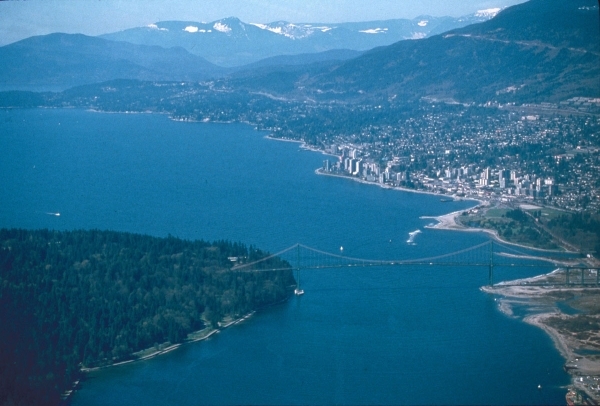
This text was written as a talk for a particular occasion, the Presidential Address on 9 January 2015 during the MLA Annual Convention in Vancouver, British Columbia. I have not removed the traces of this occasion from the text because they are integral to its argument about sites of memory. I hope my readers will imagine themselves as auditors gathered in a large room in the West Building of the Vancouver Convention Centre, built on the edge of a waterway called Burrard Inlet (fig. 1). That waterway, which is represented in several of the images that accompany this text, had—and still has—a different name in the languages of the indigenous peoples who have inhabited the Vancouver area since before it became part of an American hemisphere. Names, in languages that are ancient but also modern, are a key topic in the reflections that follow.
I
I’m grateful to you for the gift of your time. Though my talk explores a view of historical time as a multidirectional and multidimensional phenomenon, I’m aware that our shared time in this room goes in one direction in the simple sense that we’ll all be older when this session ends, and probably even more hungry, thirsty, and tired than we are now. I’ve found that the MLA convention sometimes feels like a memory marathon, with special testings of the brain muscles that allow us to recognize faces and recall the first and last names of acquaintances, and even of good friends, whom we haven’t seen for a while. Such experiences of remembering and forgetting contributed to my decision to focus on the MLA itself as one of the two sites of memory I want to explore with you this evening. The other site I want to think about is Vancouver, the place where we are now: a modern city built on a site where humans have been living for the last eight to ten millennia (Carlson 12–16).
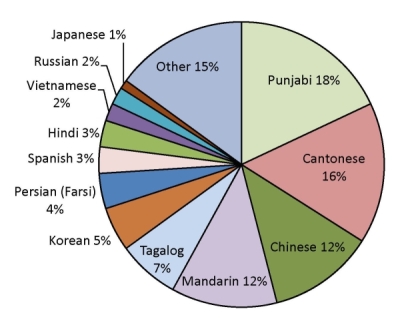
It’s a minor accident of history that the MLA is holding its first convention ever in this richly multilingual city in the Canadian province of British Columbia. I hope that MLA members will join me in turning that accident into an opportunity for thought and, perhaps, for collective self-reflection. There are indeed many fruitful ways of thinking about Vancouver and the MLA together; though I can explore only a few of them here, I’ll start with the fact that we are in a city in which the dominant language is English, as it is in the MLA. French along with English is an official language of Vancouver as it is throughout Canada, but 2011 census figures say that French is spoken by only 1.3 percent of Vancouver’s population, whereas Punjabi is spoken by 5.5 percent of the city’s total population and by 18 percent of its immigrants (fig. 2).1 Punjabi and Chinese speakers contribute to Vancouver’s reputation as the most Asian city outside Asia.2
Vancouver was decisively shaped by its history of being claimed and later colonized by the British monarchy, which continues to supply Canada with its head of state, but since the liberalization of the nation’s immigration policies in the 1970s, non-European peoples and languages have increasingly influenced Canadian culture. Their imprint led Prime Minister Jean Chrétien, in a speech delivered soon after 9/11, to make the political point that Canada was “an immigrant nation” and would continue to be one. A Native Vancouver writer, Lee Maracle, quotes Chrétien’s words in her story “Goodbye, Snauq,”3 which traces the history of an ancient indigenous village site. Maracle dramatizes the way in which the prime minister’s phrase forgets about Canada’s indigenous peoples and thus transforms a history of ongoing colonization into a narrative about immigrants and their achievements (25). That immigrant narrative certainly exists, and Maracle’s story pays tribute to the role of the Chinese in particular in Vancouver’s history because she relishes their rise in fortune; the group was scorned by many Anglo-Canadians in the not-so-distant past.4 Her point, and mine, is that Canada’s immigrant narratives, plural and contested, are intertwined with a history of colonization that continues to affect indigenous peoples. One effect is that indigenous peoples have had to learn to speak English, at a cost to their own languages that is qualitatively different from the costs borne by immigrants’ ancestral languages, which are alive and well in other parts of the world. Meanwhile, neither the first immigrant groups in Canada nor any of the later ones have found it necessary to acquaint themselves with Native languages, except for a small group of non-Native scholars. The more than thirty Native languages once spoken in this province are all classified by UNESCO as extinct or endangered. Scholars estimate that the population of aboriginal peoples in Canada declined between twenty and forty percent after the first contact with Europeans, a contact that brought smallpox from east to west along fur-trading routes before any sailing ships arrived on the Pacific coast (Wilson and Northcott 25–27). According to the 2011 census, only 0.2% of the people of British Columbia speak an indigenous language, although, as we will see, such a statistic does not do justice to the complexity of the ways in which indigenous peoples judge fluency.
One of the things that make Vancouver an exciting and thought-provoking city for members of the Modern Language Association to visit is that aboriginal languages—which are both ancient and modern—are addressed here in ways that don’t typically occur in other cities where we hold our conventions. There are strong departments of indigenous studies at Simon Fraser University and the University of British Columbia as well as at the University of Victoria, on Vancouver Island, only a ferry ride away from the downtown. Faculty members and students at these universities have joined with—and, in some cases, are—members of Vancouver’s First Nations who are attempting to foster education in Native languages. Moreover, legal and political struggles centered on indigenous claims to land are widely reported in the Vancouver media. In addition, and remarkably, at least for this visitor from south of the border, the Vancouver City Council voted last June to acknowledge publicly that the city is built on the “unceded traditional territories” of the three Native peoples, the Musqueam, the Tsleil-Waututh, and the Squamish, who occupy within the modern city’s borders small remnants (“reserves”) of their traditional hunting and fishing territories. I cannot imagine any city council in the United States issuing such a statement: it puts Native groups’ struggles against their colonization squarely in the present rather than relegating them to an ineluctably finished past. Although the city council’s vote can be interpreted as a mere gesture emanating from a liberal “politics of recognition,”5 the vote arguably performs valuable, progressive ideological work. It reminds the public that aboriginal peoples are modern political actors in a scene of ongoing struggle and debate.
Vancouver is also remarkable as a center of the protest movement that exposed the history of the abuse of Indian children in the residential school system that operated in Canada from the late nineteenth century until 1996. Many of the schools were in this province, and the University of British Columbia will be involved in creating the memory archive—including the testimony of survivors—that is required as part of the Truth and Reconciliation Commission established in 2009 as a result of the largest class-action suit by indigenous peoples against the government in Canadian history. Some of you may have attended the MLA convention session (147) on the work of this commission, which itself can be regarded as a far-from-complete negotiation of a traumatic site of indigenous memory. The session, entitled Performing Canada’s Truth and Reconciliation Act, was collaboratively arranged by the MLA Committee on the Literatures of People of Color in the United States and Canada and by the Division on American Indian Literatures. I take that session as evidence that there are areas of common concern among groups of educators who are MLA members and groups whose members—a few of whom also belong to the MLA—focus their attention on the condition of indigenous languages and cultures in Vancouver and other parts of the so-called American world.
There is, of course, no single viewpoint on what indigenous means, or how it differs from terms such as Native, aboriginal, or Indian. None of these terms comes from the languages spoken by Canada’s ancient peoples.6 And all these terms designate groups of people whose understanding of their own identities exists in ongoing tension with what the Canadian government defines paternalistically as aboriginal “status.”7 In using the term indigenous, I assume that it is currently under negotiation in complex and always tense relation to colonial laws about what constitutes Indian status. For the thought experiment I’m undertaking here, I hope it will suffice to say that there are many understandings of indigeneity—as there are of the related concepts of ethnicity and race. It seems to me as a philologist (i.e., as a scholar and lover of words) that it is helpful to think about the nonindigenous term indigeneity in relation to the genealogical modes of inquiry that can be seen at work—and at play—in many MLA fields today and that often have filiations to the work on genealogical method by Friedrich Nietzsche and Michel Foucault. The English word genealogy, which shares with indigenous the Greek word part gen, signifying birth, implies a concern with tracing origins that is inseparable from a concern with language—the logos in genealogy’s last two syllables.
Another general connection between those who work on indigenous languages and cultures in Vancouver and MLA members in a variety of fields is a desire to resist the application of utilitarian measurements of value both to certain objects of intellectual inquiry and to the persons who devote time to them. The MLA has a tradition of protecting small academic fields and less commonly taught languages in its organizational structure, and it has increased its efforts to advocate for the humanities workforce in recent years, even though some tenured members of the association do not see themselves as part of a workforce at all. It’s worth recalling that those who founded the MLA back in 1883 perceived their own objects of study and livelihoods as threatened. In a personal essay of reflection and remembrance printed in PMLA in 1984, the MLA’s long-serving executive secretary John Hurt Fisher, summarizing observations a former MLA leader named William Riley Parker had made in 1953, noted that “the MLA was created to assert the value of the study of modern, that is, nonclassical, languages in a [college] curriculum dominated by Latin and Greek” (“Remembrance” 398). But nearly thirteen years earlier, when Fisher was embroiled in debates about the mission of the association, he described the founders’ agenda quite differently. In a report to the members to which I’ll return later, he asserted that the MLA was “born . . . as a militant and activist association, intended to mobilize modern language teachers to demand their place in an educational hierarchy which placed little value on their subject” (“Report” [1971] 472).
It is another irony of history that teachers of English, French, Spanish, Italian, and German in colleges in the northeastern United States should have perceived teachers of classics as their enemy; in 1883 the ancient languages were still prestigious at elite colleges on the East Coast, but they hardly figured as major players in the system of educational values that was embodied in the public land-grant universities created under the Morrill Act of 1862. Applied science was and remains at the center of those democratic experiments in mass education, which implicitly and sometimes explicitly ask teachers of all subjects to impart something demonstrably useful to students. Having to quantify how what you teach and value contributes to the growth of the nation’s economy is a task that MLA members share not only with their colleagues in classics departments today but also with those groups in Vancouver who are concerned with the teaching and learning of indigenous languages. Studying such languages has little (if any) economic or military value; it must be justified politically through certain ideas about the value of cultural difference in a pluralistic society. Those who speak and write for indigenous cultures in Vancouver and elsewhere have significant lessons for the MLA, I suggest, and I turn now to consider samples of their writing. My samples are in a dominant colonial language, English, but they invite attention to the past, present, and future of non-English languages spoken by small numbers of people.
II
I want to consider four written acts of communication that illuminate the language situation of indigenous Vancouver: that is, its existence as a temporal palimpsest in which acts of communication made in the present are shaped but not bound by a past that is constantly reinterpreted with an eye on possible futures. In the final part of this talk, I will turn back to the MLA to reflect on it as a community with many written acts of communication that also create a “language situation.”
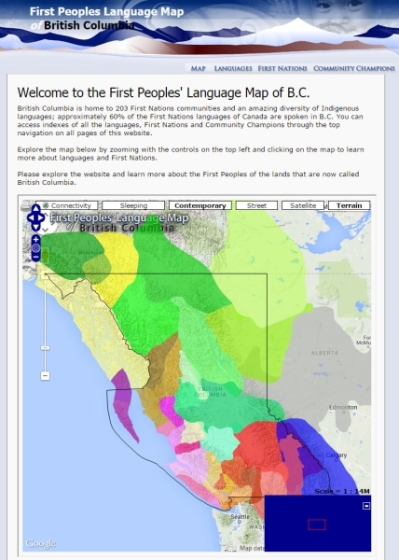
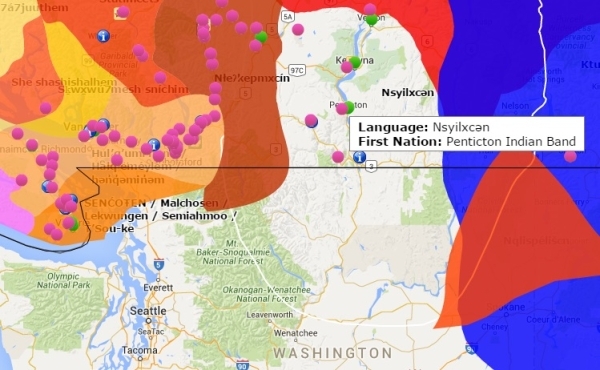
My first object of attention is a remarkable collaborative project called First Peoples’ Language Map of British Columbia (fig. 3). This screen shot of the language map’s welcome page is a static reduction of an interactive site made with input from educators located both in universities and in the sixty-three Native communities of British Columbia. The information on the site comes from the communities and can be updated, though how often that happens isn’t clear to me as a novice interpreter of this complex site. The opening page represents the makers’ colorful vision of a distant past when indigenous languages occupied the landscape fully, in a sweep that extends into what is now the United States and the Canadian province of Alberta (fig. 4). The welcome page invites you to think of languages in their spatial, social, and technological dimensions. The page also uses an interesting bio-historical category, “sleeping,” to refer to languages that have no fluent speakers. But “sleeping” is not a euphemism for being extinct: languages classified as sleeping turn out on further inspection to have some semifluent speakers and, typically, a somewhat larger number of learners. I therefore interpret “sleeping” as a sign for uncertainty about and desire for the history and future of certain endangered languages in which living-language educators and learners remain invested. Sleeping preserves the possibility of awakening.
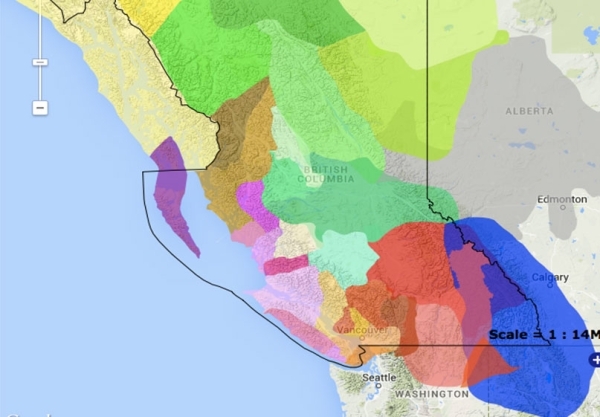
My second cultural object is a poem called “History Lesson,” by Jeannette Armstrong. She was born on the Penticton Indian Reserve in an isolated valley marked in figure 5 on the language map. She grew up speaking Nsyilxcən; she also learned English. The introduction to the selection of her poetry in an anthology she coedited, Native Poetry of Canada, says that she frequently acted as a “translator for members of her community” (Armstrong and Grauer 106 [fig. 6]). “History Lesson” begins with a moment of monstrous birth, a catastrophic genesis when Christopher Columbus made his landfall on an island he renamed San Salvador:
Out of the belly of Christopher’s ship
a mob bursts
Running in all directions
Pulling furs off animals
Shooting buffalo
Shooting each other
left and right
Father mean well
waves his makeshift wand
forgives saucer-eyed Indians (110)
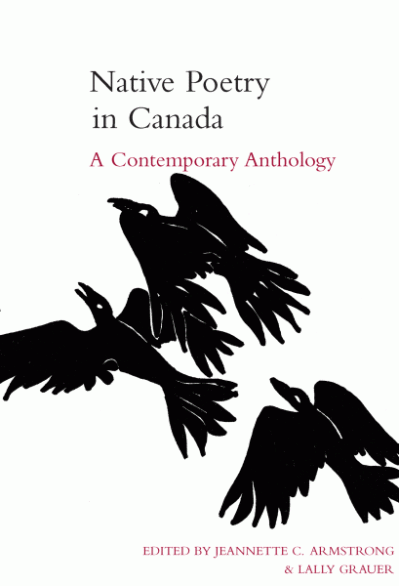
Armstrong compresses time and space; she pictures the invaders as destructive children racing toward North America. The figure of the father, whose makeshift wand perhaps inseminated Columbus’s ship, gives fake forgiveness to another set of children, the saucer-eyed Indians who credulously believe in him. “Father mean well”—the line can be read in at least two ways: as a sign of the narrator’s lack of mastery of English (standard English would have “Father means well”) and as an imperative statement (“Father, mean well!”). Like all the other lines in the poem, this one eschews punctuation, but the verb form makes the line stand out as a self-contained unit; it’s oddly discontinuous with the simple descriptive statements in the stanza’s next two lines, in which the father “waves” his wand and “forgives” people who have committed no sin. The line about how the father should or does “mean” calls attention to a problem of meaning that the poet sees as inherent in the colonial scenario. The line signals both the narrator’s resistance to the father tongue and her willingness to play with it. It is perhaps the chief of the dangerous gifts that the poem goes on ironically to inventory as including smallpox, Seagram’s whiskey, and Rice Krispies. The poem eventually locates distinctly Canadian Indians living near the snap, crackle, and pop of smokestacks and the gaping holes from which miners pull money, the “green paper faces / of a smiling English lady.” Armstrong’s “History Lesson” enjoins both her Native and her non-Native anglophone readers not to forget or forgive what Christopher Columbus began.
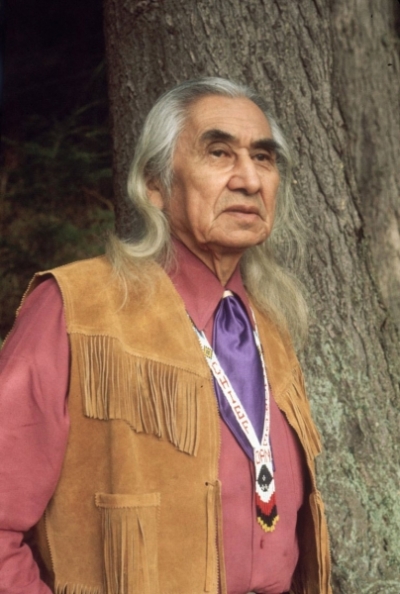
Her anthology begins with selections of poems by a native of Vancouver known in English as Chief Dan George (fig. 7). He is the key figure of my third story about the indigenous language situation. Like Armstrong, George offers a history lesson to anglophone readers, though his has a later origin: the birth of Canada as a confederated nation-state in 1867. Named Teswahno in his mother tongue, George was forbidden to speak that language in the North Vancouver residential school in which he was enrolled at age five. Some of you may remember his name and face; as an actor, he played the wise and kind Cheyenne chief Old Lodge Skins, who adopts a character played by Dustin Hoffman in Arthur Penn’s 1970 film Little Big Man. Elbert Ventura called Penn’s movie the “angriest of all revisionist Westerns,” and many have interpreted its portrayals of the United States Army’s massacres of Native Americans at Sand Creek and Washita as allegorical comments on the United States military’s behavior in Vietnam and especially at My Lai (“Little Big Man”). Though the movie has been criticized for its lack of evenhandedness and its use of clichés about corrupt Europeans harming noble savages, it asks viewers to wonder whether evenhandedness is always a good thing. The movie is worth remembering today in part because it gave an unprecedented major role to a Native Canadian who had publicly expressed his determination to “grab the instruments of the white man’s success—his education, his skills” in order to make the next century less catastrophic for his people than the previous one had been. In a prose poem called “A Lament for Confederation,” George uses an untranslated indigenous word, seelanum, to mark his difference from those whose language and system of measuring time he has unwillingly had to adopt: “How long have I known you, Oh Canada? A hundred years? Yes, and many many seelanum more.” (The word means lunar months.) George read this poem to an audience of 35,000 people at Vancouver’s Empire Stadium in 1967. The speaker is out of sync with the modernity into which he feels he has been catapulted. He describes his condition in a stanza that uncannily anticipates a sentence—“I can’t breathe”—that is appearing on athletes’ T-shirts and as a rallying cry for protests like the one organized in Vancouver today by MLA members commemorating Eric Garner and excoriating the injustice of his death. “In the long hundred years since the white man came,” George writes, “I have seen my freedom disappear like the salmon going mysteriously out to sea. The white man’s strange customs[,] which I could not understand, pressed down upon me until I could no longer breathe.”
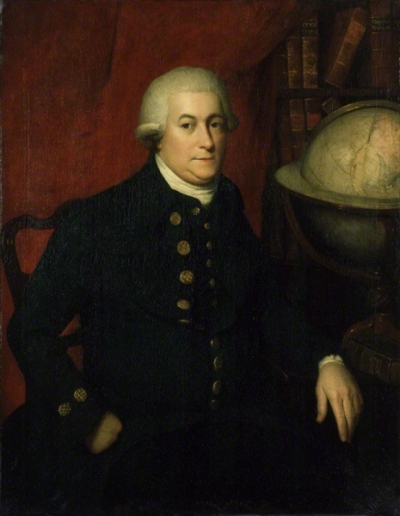
My final cultural document about the indigenous language situation in Vancouver takes us back before the birth of Canada as a nation to a day in June 1792 when a British naval captain of Dutch ancestry named George Vancouver explored the waterway we can see from the convention center’s windows (fig. 8). Vancouver came to this region in a ship called Discovery; he claimed the land for his king by giving English names to over four hundred places on the northwest coast. His orders were to secure a “restitution of the territories on which the Spaniards had seized, and also to make an accurate survey of the coast, from the 30th degree of north latitude northwestward … ; and further, to obtain every possible information that could be collected respecting the natural and political state of that country” (qtd. in Meany 12).
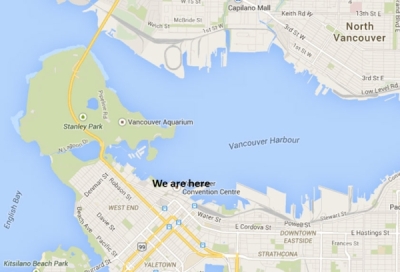
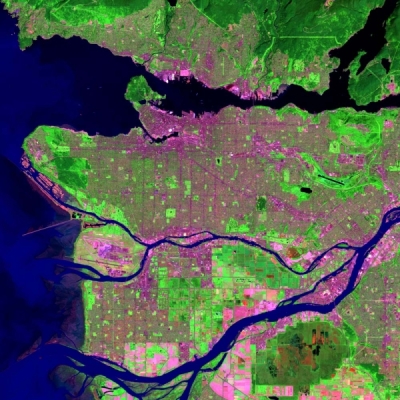
Vancouver was careful and detailed in his journal entries about geologic and botanical aspects of the coastal landscape he was exploring. It’s striking, though, given his orders to obtain information on the political state of the country, how incurious he was about what its people were saying to him when they met his ship with their canoes in the inlet he would soon name after his naval colleague and friend Harry Burrard. It’s an irony of history and geography that the people he describes in his journal as having given him several cooked fish—and to whom he gave some pieces of iron in return—were likely from a Native group whose name ties their identity to the place that Vancouver was symbolically appropriating for the English: Tsleil-Waututh means “People of the Inlet” (Tsleil-Waututh).8 These were the people that Dan George would later remember as his ancestors, and they were known as the Burrard Inlet Band before the term Band was replaced by First Nation in the 1980s. Vancouver’s printed journal reveals that he didn’t have the desire or time to listen seriously to the two collective speech acts made by the Native people he encountered. When they paddled forward to talk, he thought they were engaging in what he called “consultations” among themselves on matters that remained a “profound secret to us.” He found “[t]his sort of conduct” suspicious and advised that it should “ever be regarded with a watchful eye” (301). He could not imagine a social group that behaved in a fashion unfamiliar to him and so did not understand the Natives’ communication. They were making ceremonial speeches of welcome to strangers—as they had done for millennia according to a custom that Larry Grant shared with us tonight at the Welcome Ceremony. He represents the Musqueam First Nation, which has an ancient village at the mouth of the Fraser River (fig. 9). The Tsleil-Waututh people have a small reserve on the north side of Burrard Inlet, and the Squamish have a property to the east on the map. The Convention Centre, site of the MLA convention, is on the south shore of Burrard Inlet, called Vancouver Harbor in figure 10. The inlet, now narrower than it was in 1791, is visible from the air in figure 11, flowing into the Georgia Strait, which Vancouver named after his king and perhaps himself.
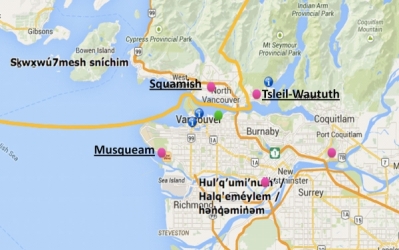
The people whom Vancouver encountered didn’t inhabit the land as its owners in anything like the dominant modern sense of ownership. They traveled between established seasonal encampments in a rich ecological system that was a crossroads for trade, and they communicated with others who spoke a number of Coast Salish languages in addition to the three dialects of Halkomelem spoken in the Vancouver area: Hul’q’umi’num’ (spoken by “six separate but closely related” groups on Vancouver Island), (or Hənqəminəm, a “downriver” dialect spoken by the Musqueam and Tsleil-Waututh people), and Halq’eméylem (an “upriver” dialect spoken by the people and some of their close neighbors in the Fraser River valley [First Peoples’ Language Map]).
The language map tells us that Hənqəminəm is “sleeping” because no one speaks it fluently in the Musqueam Nation, which has a population of 644 living on the reserve and 671 living off it, or in the Tsleil-Waututh Nation, with a total population of 508. But “sleeping,” as I suggested earlier, signifies a reality more complex—and less readily knowable—than the map indicates with its statistics about three kinds of speakers: those who are fluent in the language, those who understand or speak it somewhat, and those who are learning it. A language is apparently considered sleeping when no one speaks it fluently but there is still enough knowledge about it in the community for it to be learned. But how does “sleeping” apply to Hənqəminəm if it is the native language of a contemporary leader of the Musqueam Nation, who appears to have perfect mastery of it when he offers a speech of welcome to MLA members and to an audience that includes indigenous-language scholars from the University of British Columbia—where Grant himself teaches his version of downriver Halkomelem? When I asked him why his language was categorized as sleeping on the map, he explained that while he is perfectly capable of speaking and teaching it, he does not regard himself as fluent because he does not have the vast knowledge of Musqueam culture that was possessed by an elder who died years ago. Many Native people, he suggested, would find it immodest to claim fluency in their language at a time when their cultural traditions are so endangered by a long history of enforced assimilation and by the need in modern urban life to conduct almost all legal and economic business in English. Grant’s example cautions us against assuming that we understand what counts as linguistic information even when it is conveyed on an apparently ultramodern interactive language map. His example also reminds us, however, that indigenous peoples in Vancouver are pushing back against the shrinkage and apparent loss of their languages. On the language map, which includes Internet connectivity as one of its categories of information, and on the burgeoning Web sites of individual Native communities, there are impressive lists of resources for learning indigenous languages as a child or an adult: digital dictionaries, games with wonderful graphics, recordings of traditional stories and songs, and many other materials that blend education and recreation—as indeed the map itself does. That such resources have been created and made available even in communities with languages categorized as sleeping suggests to me that the makers of the First Peoples’ language map are working—and playing—as educators who are hopeful about the uncertain future even as they collect depressing information on the language situation today and show its drastic falling off since the precolonial past.
III
The MLA is another site of memory in which language educators face an uncertain future that is shaped but not bound by a multilayered past. I want now to look back at some documents from the transformative conventions of 1968, 1969, and 1970, when the Delegate Assembly was born in response to members’ demands for a more democratic association that would take more fully into account the needs of women, graduate students, nontenured faculty members, and those in ethnic minorities than the organization had done in the past—or was seen to have done by members who insisted that MLA officers should be selected by the entire membership rather than by a “self-perpetuating” Executive Council. In many ways, the new MLA envisioned in the late 1960s and the 1970s is the one we now have. But it is still facing old and seemingly intractable problems.
A striking example of such a problem has to do with whether or not a scholarly society should engage with controversial social issues that seem to some members irrelevant or even harmful to the society’s professional status. John Hurt Fisher addresses this problem directly in reports he made in his role as executive secretary during the late 1960s and early 1970s. As I mentioned earlier, Fisher was the MLA leader who pictured the association’s founders as “militant” advocates of their subjects; when he wrote that sentence, he was attempting to mediate between competing factions in an MLA that, eighty-five years after its founding, seemed to some members to have lost sight of its true mission, which they defined in terms of dispassionate scholarly inquiry and exchange, in contrast to colleagues who embraced a mission of advocacy on a broad range of issues. Fisher reminds his divided audience that their association was founded because a group of scholars and teachers believed that they needed collective action and advocacy to survive in an academy—and a society—that had little regard for their subject matter. In two addresses at the 1969 convention, one at a general session of a kind we no longer have—unless it is this occasion, the Presidential Address—the other at a business meeting, which was the precursor to our modern Delegate Assembly meeting, Fisher sought to negotiate with his audiences about the MLA as a site of competing memories. His comments, like the competing resolutions at the 1968 and 1969 meetings about whether or not the association should take stands on issues that some members saw as unrelated to their professional interests, provide an interesting historical gloss on the questions that will be debated at the Delegate Assembly’s open discussion tomorrow. With what seems like eerie prescience, Fisher in 1969 wrote, “The problem that faces the Association is to what extent we shall accept alongside [our] … traditional scholarly activities socially oriented activities such as improving the status of women in the profession, assisting in the education of minority groups, and influencing the distribution of the wealth of the nation for peace and for war. The more the MLA concerns itself with problems such as these, the more it will embroil itself in controversy. Controversy will lose it some members and friends, as is already being demonstrated. But one hopes that the majority of our profession will not want to sit on the sidelines while important decisions affecting their intellectual and temporal lives are being made” (“Report” [1970] 535). Fisher also noted that all four of the controversial resolutions from the tumultuous convention of 1968 had received a majority of yes votes from the membership during the ratification process. Indeed, he remarked that these votes drew the largest proportion of the membership—forty-four percent—that had ever participated in a vote in the MLA’s history. To give you an idea of what this means, a resolution that the MLA should urge the federal government to withdraw immediately from an “immoral, illegal, and imperial war” received 6,031 yes votes and 5,727 no votes (“Actions” 1232–33). Contrast that with a recent MLA vote on a controversial resolution that failed to draw ten percent of the membership to express an opinion. Fisher argued in 1969 that the large percentage of voters and the fact that a majority of them voted yes on controversial issues provided “significant evidence that many members do not object to the MLA’s taking a stand on controversial topics” (qtd. in “1969 Business Meeting” 643). I don’t know if he was right (what about the sixty-six percent who didn’t vote?), but I do know that the question he was addressing about controversial issues is still with us, unresolved, today.
The most controversial resolutions discussed by MLA members during the late 1960s and early 1970s had to do with the Vietnam War, which provoked debates as heated as those that are occurring now—in the MLA and other scholarly associations—about Israel/Palestine. There were also debates and close votes about issues that pertained to the MLA’s organizational structure as it allegedly refracted the injustices of the society at large. A report from the Commission on the Status of Women in the Profession that Florence Howe read at the business meeting of the 1969 convention, for instance, drew sharp parallels between discrimination against women in the United States, in the academy, and in the MLA itself, where, she claimed, twenty-five percent of the membership was female but less than one percent of the leadership roles were held by women in 1969 (qtd. in “1969 Business Meeting” 647). That statistic, at least, has changed dramatically over the last forty-five years, and it has done so, in part, because of the analysis and publicizing of data about gender ratios that was collected by the commission and the MLA staff.
Women clearly occupy more leadership positions in certain academic professions, including ours, than they did a half century ago, but there is a well-studied tendency for professions to see a decline in pay and prestige as their workforce and leadership become feminized (Kroeger), and case studies and data suggest that despite popular recent narratives about the “decline of men” in what some journalists optimistically call the postrecession economy of the United States, well-educated women continue to be clustered in lower-paying positions in many professional arenas inside and outside academia (Blair-Loy, Pecenco, and Cech). Still, it’s possible to celebrate genuine progress for some groups of women in the MLA and in its members’ institutions. There have been fewer signs of progress, however, on two other issues that generated resolutions at the 1969 MLA convention. One of these has to do with the distant relation between MLA members who are presumed to be employed in institutions of higher education and teachers of language and literature at other levels of the educational system in the United States. The other issue has to do with what was being newly perceived in 1969 as a bad job market for those with doctorates in language and literature fields.
In 1970 MLA members overwhelmingly approved a resolution of 1969 stating that college teachers of language and literature should take more account than they were at present of the “conditions and needs of primary schools, high schools, and junior colleges”; the resolution exhorted the MLA to “encourage departments of English, linguistics, and the foreign languages to regard the training of primary, secondary, and junior college teachers as an obligation” (“1969 Business Meeting” 649–50). It’s easy to criticize the hierarchical assumptions of this resolution, but it’s not so easy to point to signs that the MLA membership, which now includes many more faculty members from two-year colleges than it did even fifteen years ago, has taken action to nurture the seed of truth in the 1969 statement.
The MLA staff and several groups of members have worked hard in recent years to bridge the gaps between humanities educators at different levels of our educational system. In 2010, for instance, soon after the Common Core State Standards (CCSS) for K–12 education appeared in draft form, leaders of the MLA and the National Council of Teachers of English (NCTE) collaborated on a letter criticizing the document for its indifference to the teaching of languages other than English, among them the heritage languages spoken at home by many students who live in the United States. The MLA-NCTE letter also criticized the standards for English language arts (ELA) for their lack of attention to the complexities of teaching writing and rhetoric. Our letter—like many other comments from educators—had no effect on the ELA standards as published on the CCSS Web site; the site indeed lacks any mention of a process for revising the standards in response to teachers’ experiences with them. A number of panels at recent MLA conventions have been devoted to debating the strengths and weaknesses of the standards,9 and at this year’s convention two panels focus on specific aspects of the standards—their concepts of “college readiness” and “text complexity”—with the aim of making constructive criticisms and bringing them to the attention of the public and, we hope, of educational policy makers too. These two panels, sponsored by the MLA Executive Council and the executive director’s office, testify to the association’s recent efforts to address issues that pertain to K–16 education as an ensemble of pedagogical theories and practices that should create a coherently sequenced experience of the humanities for our students. MLA officers and staff members are looking for creative ways to foster educational alliances through projects focusing not only on the CCSS but also on the teaching of languages other than English and on instruction in the emergent field of writing studies. During my term as an officer, I chaired a new Executive Council planning subcommittee on K–16 education, and I hope that the Delegate Assembly will discuss forming a sister committee at the meeting tomorrow. Margaret Noodin, an elected member of the Delegate Assembly Organizing Committee and a scholar and poet who is interested in the teaching of Native American languages in public schools, has agreed to chair the Delegate Assembly committee if it comes into existence. Looking back at the convention of 1969, I would say that we don’t need another resolution about college teachers’ obligations to pay attention to their colleagues working at other levels of the United States educational system, with its crazy patchwork of public and private, for-profit and nonprofit institutions. Instead, and with the participation of MLA members who teach in two-year colleges, we need to think about partnerships that could begin modestly in local communities and that would involve multidirectional communications and exchanges of materials instead of the imparting of wisdom from those in higher education to those presumed to be lower because they typically teach students too young to be judged college-ready by the authors of the CCSS.
Three other resolutions of the 1969 convention addressed an issue that not only is still with us but has worsened beyond belief. In language that seems both prescient and naive, members attempted to solve a newly perceived problem confronted by job seekers who had earned doctorates in MLA fields. “[F]or the first time since 1952,” one of the resolutions states, “a substantial number of job seekers cannot find employment; therefore, be it resolved that the MLA shall establish an unemployment fund by charging departments listed in PMLA an amount sufficient to cover the costs of such a fund.” I love the proposers’ confidence that departments could or would step in to fix the shortfall, which the resolution obviously sees as temporary. A second proposed resolution expresses dismay that job candidates have “little protection against exploitation and no recourse when it occurs.” This resolution argues for banning departments from using MLA convention facilities for interviews unless the departments agree “that initial contracts for teaching positions be for a minimum of three years” and “that if employment is to be terminated after the initial contract, the teacher be so informed in writing no later than the beginning of the third year of the contract, with reasons for termination being supplied in writing at the same time” (“1969 Business Meeting” 652). These two resolutions weren’t approved by the members present at the business meeting. It is perhaps not surprising that the only resolution that did pass—and was subsequently ratified by the entire membership—called for the establishment of an MLA advisory committee to study the job market problem and come up with solutions for it.
It has, alas, not proved so simple to solve. The problem of the job market remains particularly acute in English and foreign language departments, as the MLA’s 2008 report Education in the Balance shows. Prompted by that report, the MLA officers wrote department chairs to give detailed suggestions about what they and other tenured faculty members could do to improve the working conditions of adjuncts. The MLA established the Committee on Contingent Labor in the Profession, which published a thoughtful set of guidelines for best practices in 2011 called Professional Employment Practices for Non-Tenure-Track Faculty Members: Recommendations and Evaluative Questions. Moreover, the MLA, along with the Association of Departments of English, the Association of Departments of Foreign Languages, and allied organizations such as the Conference on College Composition and Communication (a section of the NCTE) and the American Association of University Professors, has regularly issued critiques of the long-term, dramatic increase of non-tenure-track positions in the academic workforce. There are disagreements about how many PhDs from the last twenty years now hold contingent (or adjunct) positions in institutions of higher education, and there are also disagreements, within and outside the MLA, about what should (or can) be done about the situation. But hardly anyone in the MLA today would dispute the idea that there is a job market problem that is much more serious than members understood it to be in 1969. The MLA staff over the years has done a great deal to analyze the problem, producing widely respected data-driven reports. But the MLA’s recommendations about adjuncts’ salaries and working conditions have not been heeded at many institutions (consider whether your institution abides by the modest recommendation that non-tenure-track faculty members be paid at least $7,230 for each standard, three-credit, semester-long course). As Michael Bérubé observed in 2013, the MLA’s guidelines and recommendations about the working conditions of both tenure-track and non-tenure-track faculty members “are still insufficiently disseminated and understood,” but as he also remarked—and here is the rub—the “implementation and enforcement” of any MLA recommendations “can be undertaken only at the local level, at individual institutions” (“Avenues”). I would add that shining the light of publicity on noncomplying institutions may sometimes produce changes in policy, though evidence of when that happens, even in small ways, needs to be gathered and shared. The statements by Bérubé that I just quoted come from his introduction to the published version of the papers presented at his 2013 Presidential Forum. He took the unprecedented step of inviting only non-tenure-track faculty members to speak in that forum, which was entitled Avenues of Access: Non-Tenure-Track Faculty Members and American Higher Education. One of the speakers, Joshua Boldt, in 2012 had founded an important information-gathering project that asks adjuncts from everywhere in the United States to submit data (anonymously) about their pay, benefits, and working conditions (fig. 12). Assisted by the Chronicle of Higher Education and widely discussed in social media, The Adjunct Project, like First Peoples’ Language Map of British Columbia, allows members of a geographically dispersed and economically disadvantaged group to share information and thus to join a knowledge-producing community with the potential to advocate for change. Boldt’s crowdsourced Adjunct Project is one of several efforts—among them the MLA’s own Academic Workforce Data Center—that push back against an understanding of our economic system as operating according to impersonal and immutable principles of supply and demand.

If we think of that system as a phenomenon that is generated—and regenerated—not by nature but by human beings using language to rationalize and promote certain social effects, then language teachers in the MLA are well equipped by their training in persuasive rhetoric to propose and pursue alternatives to the status quo. By so doing, MLA members can increase their organization’s effectiveness as an advocate for the humanities workforce.

Given that humanities teachers, like poets and other fiction makers, have had to defend themselves for many centuries against charges that they are useless (or, worse, harmful) members of society, I want to suggest that we in the MLA have something to learn from a group such as Canada’s Idle No More. Wittily responding in its name to the perception of indigenous people as parasites on the body politic, this group, founded in 2012 by three Native women and a non-Native ally, has become an active critic of the status quo in Canada through canny uses of social media and through a complex politics of alliance (fig. 13). Through events ranging from teach-ins and stand-up comedy nights to protests that occur simultaneously in multiple sites around the world, Idle No More argues for the right to a “sustainable” life—for people as well as the environment. While some of Idle No More’s goals are radical and indeed conceptually unprecedented (the group calls for full legal sovereignty for First Nations in the larger federal entity of Canada), the goal of ensuring the existence of employment opportunities and a social safety net that allow all citizens a sustainable life makes Idle No More a potential ally of professional societies like ours, which focus attention on the well-being of multigenerational groups in the larger society of the modern nation-state.
Looking back once more to the MLA’s past, I move toward my conclusion by noticing that among the seldom remembered documents of the 1970 convention was a resolution urging the MLA’s officers to set up a Commission on Faculty Unions. The commission was to present a report to the membership on such topics as “the role of the university teacher as worker—i.e., one who sells his or her skills on the open market” and “arguments for and against teacher unions or collective bargaining units as distinct from professional organizations.” The resolution’s proposers begin by stating, “In the light of the increasing economic insecurity of college teachers, reflecting the overall economic crisis, … we recognize the need to explore the possibilities of organized collective action by college teachers” (“1970 Business Meeting Actions” 597). I’m not sure what happened to this resolution; although it was approved by a majority of the members who voted on it, I haven’t been able to find the commission’s report, which was supposed to build on data gathered with the help of newly hired staff members. The commission was to include members from several organizations that served as bargaining agents for college teachers and teaching assistants. Whatever the commission’s fate, perhaps it’s now time to return to the negotiating table of institutional memory and ask that the ideas motivating that old resolution be dusted off and reexamined. What if a substantial number of MLA members were seriously to consider themselves part of a humanities workforce? If this happened among tenured as well as nontenured faculty members, at private as well as public institutions, would it foster ideas for improving academic employment that we could pursue more strenuously in the MLA—and in our alliances with other groups and at our home institutions—than we have in the past? The MLA is on record as supporting faculty members’ right to engage in collective bargaining (“Resolutions”). What if the MLA were to form a committee charged not with making an institutional statement of support for faculty unions but rather with providing practical support to MLA members who want to learn about unionization and see a new kind of faculty union come into being on their campuses? I’m thinking here of the interestingly tautological name given to collective bargaining units that include the whole faculty at an institution: “the one faculty union.” Such a creature was recently created at the University of Illinois, Chicago, after four years of often acrimonious negotiation between the faculty and the administration. During those years of negotiation, the faculty members had no raises, but now they have had one, and nontenured faculty members have gained benefits they did not have before. That new union is unusual not only because it includes the entire faculty but also because it was created by and for the faculty.
This is a propitious historical moment for thinking again about faculty unions because the National Labor Relations Board issued a ruling recently (on 16 Dec. 2014) that overturns the Supreme Court decision in Yeshiva, the famous case of 1980 in which a majority of the justices ruled that faculty members in a private university were managers and therefore not allowed to join a union (NLRB). Considering that decision in the light of the erosion of faculty rights in the last thirty-five years and noting that the faculty members in Yeshiva were not even hired on a tenure track, the NLRB’s recent ruling, in the case of Pacific Lutheran University and Service Workers International Union, opened a door for faculty organizing that has long been shut (Jaschik). The MLA worked with the Coalition on the Academic Workforce to create a survey of contingent faculty members in 2010 (fig. 14); the MLA staff provided the editorial and production work required to create and publish the resulting report, A Portrait of Part-Time Faculty Members, in 2012, and the association maintains a Web site for the coalition where visitors can access the report and the data files. So my suggestion that the MLA devote more resources to serving members who want to investigate organizing possibilities in their institutions would not mean a change in the association’s direction. It would, however, need support from the membership and particularly from those faculty members who have the increasingly rare advantage of secure employment.

The accident of history that brought the MLA to Vancouver might ultimately provide pragmatic inspiration for changes in the ways that humanities professors think about what they can say and do to resist the language of a market system that has pushed most humanities teachers into the class often called the “precariat”—a term that has become shockingly familiar. A national group called the New Faculty Majority, which was formed to improve the working conditions of adjunct and other contingent college teachers, has urged postsecondary educational institutions to pursue the Program for Change, devised by Jack Longmate and Frank Cosco on the basis of their work at Vancouver Community College (fig. 15). Popularly known as the Vancouver Plan, the Program for Change offers a set of clearly defined paths toward remedying the systemic payment of “poverty-level incomes” to a large number of professional postsecondary educators, who work in “complete insecurity” (Longmate and Cosco 1). As evidence that the program’s goals of higher salaries, health benefits, and multiyear contracts for non-tenure-track faculty members are feasible, the authors observe that many of their goals have already been implemented—through collective bargaining and other means—in colleges and universities in British Columbia and Québec, as well as in the public university system of California (2). Though the changes envisioned by the Program for Change may seem modest in terms of social justice, the call for them offers a welcome alternative to labor practices that have gradually come to seem normal to many administrators and tenured faculty members.10
The quest to become rich is not what drives most people who desire to make a career in humanities teaching and scholarship. While I don’t presume to speak for all my students and colleagues, much less for all members of the MLA, I suspect that a significant number of us would agree with Dan George that there is something deeply wrong with the modern Western dictum Time is money. George was willing to transform his modes of communication for a new age; he went from Burrard Inlet to Hollywood, after all, and he seized the opportunity the City of Vancouver offered him to speak to an enormous crowd about the dark story lurking in their centennial celebration. From watching the hilarious scene in Little Big Man where his character solemnly sets off to die on a hilltop and then finds himself unable to do so—much to the relief of Dustin Hoffman’s character—I surmise that Dan George might well have relished the First Peoples’ language map, a digital creation that takes time to understand, invites questions about the subtle differences between fluency and semifluency, and refrains from pronouncing languages dead when they might still be alive. But George also devoted his talents as a performer and writer to criticizing the modern age for forgetting aspects of the past that held immeasurable value for him. In a poem titled “If the Legends Fall Silent” (1974), he writes about the slow time that a thought needs if it is to grow. Such time once existed as silence between spoken words, he suggests, for silence was “a sign of deliberation.” “In these new times of a modern world,” however, “where everything has become of value / silence has become time. / Time unused has become time wasted.”
George and many other indigenous writers across the Americas have resisted the modern view of time as wasted unless it is used in ways that the dominant society values. I have been suggesting here that members and prospective members of an organization that calls itself a modern language society might take a leaf from indigenous language teachers—in which group I include writers such as George—and think about an attitude toward and experience of time that is not premodern or antimodern but, instead, an alternative way of mindfully inhabiting modernity. Informed by genealogical habits of thought that search for rhizomatic continuities with the past, the alternative way of inhabiting the present that I have associated with Vancouver as a site of indigenous memory is also alive, if not yet fully fledged, in the MLA. I think that it is our unceded territory as teachers of the humanities. We need to work with all the wit we can muster to negotiate for its survival.
For their generous help during this paper’s several stages of composition, I am grateful to Nicky Agate, Gina Bloom, Jean F. Carr, Anna Chang, Frances E. Dolan, Rosemary G. Feal, Mary Anne Ferguson, Susanna Ferguson, Marianne Hirsch, Dyani Johns-Taff, Mary Beth Rose, and David Simpson. I also thank Steve Bury, Fran Dolan, and Susanna Ferguson for their work on the images that accompany this text. I received valuable advice on the languages, cultures, and ongoing legal struggles of indigenous peoples in Canada, and in the Vancouver area in particular, from a set of talented scholars: Patricia A. Shaw, Linc Kesler, Peter Kulchyski, Dylan Robinson, and Margaret Noodin. Finally, I would like to thank Larry sʔəyəɬəq Grant, of the Musqueam Nation, for offering a welcome to the audience of MLA members who heard this paper as a Presidential Address in Vancouver.
1. The statistics in the pie chart are from “Punjabi.” For further information about the language situation as reported in the most recent census, see “Languages.”
2. According to Todd, forty-three percent of the metropolitan area’s population is of Asian descent.
3. Snauq, meaning “place of masks,” is an anglicization of the name of an ancient indigenous winter village site on the south side of what is now called False Creek; known as “sən’a?qw to the Musqueam and Sen’ákw to the Squamish” (Russwurm), the site included a sandbar island that was used by several indigenous peoples as a meeting place for fishing, weaving, feasting, storytelling, and making social arrangements, including marriages. The Squamish people who inhabited the mainland part of Snauq after it was designated an “Indian Reserve” by the colonial government in 1869 engaged in a long struggle to retain official title to the land; Maracle’s story offers a darker account of that history than does the Web site for the place Snauq has become today: Granville Island (“Story”). The Squamish leaders sold the rights to Snauq in the 1990s. Maracle, who was born into the Squamish First Nation, does not blame them for doing so, but her story draws ironic connections as well as contrasts between Chinese immigrants to Canada and the country’s aboriginal inhabitants.
4. Descendants of Chinese workers who had made enormous contributions to the building of the Canadian Pacific Railway—a project that was critical to Vancouver’s transformation from a town named Granville with a population of 5,000 in 1887 into a city of 100,000 in 1900—gained citizenship rights only in 1948. A year earlier, Prime Minister William Lyon Mackenzie King insisted that white “homogeneity … ought to characterize the people of this country if we are to be a great nation” (qtd. in Kelley and Trebilcock 6). King’s view has by no means disappeared: see, e.g., Duchesne.
5. See Povinelli 13 for a critique of “brackets of recognition” in exculpatory liberal accounts of “ongoing social harm.”
6. Although these languages are often viewed as belonging to “oral” cultures, defined as primitive because they lack what counts as literacy in a unidirectional theory of history, the opposition between orality and literacy has been challenged by Native and non-Native scholars (e.g., McLeod; Ferguson, Dido’s Daughters 43–61).
7. For a discussion of this vexed legal concept, which has a complex history and which many Native scholars and leaders regard as a form of apartheid, see Crey and Hanson, who provide a bibliography.
8. According to Kirsten Baker-Williams, however, it was the Squamish people, not the Tsleil-Waututh, who first met with Vancouver in June 1792. These two peoples lived close to each other, and their histories have been linked ever since smallpox decimated the Squamish in the 1770s, before the first contact with the Spanish or the English, who are each represented as coming first in different sources. Though the Tsleil-Waututh and the Squamish spoke tongues different enough from each other to be classified as languages rather than dialects by modern scholars, the two peoples’ histories, from my nonexpert perspective, seem to involve both mixings and rivalries. Baker-Williams cites an English version of a Squamish account of the “first encounter” with Vancouver (16–17). Dan George was a member of the Tsleil-Waututh group; his granddaughter Lee Maracle calls herself Squamish by birth, Stó:lō by marriage.
9. For further information on what the MLA has done about the issues posed by the CCSS, see Ferguson, “MLA.”
10. Michael Bérubé, a past president of the MLA, offers a thoughtful and sympathetic critique of the Vancouver Plan; in his view, it does too little to preserve tenure as a bulwark of academic freedom and to value the PhD as the appropriate degree for postsecondary educators. He offers an alternative plan for improving the working conditions of nontenured faculty members in “New Model”; see also his forthcoming book, cowritten with Jennifer Ruth, The Humanities, Higher Education, and Academic Freedom: Three Necessary Arguments.
Works Cited
“Actions of the 1968 Business Meeting.” PMLA 84.5 (1969): 1231–33. JSTOR. Web. 19 Dec. 2014.
Armstrong, Jeannette C. “History Lesson.” Armstrong and Grauer 110–11.
Armstrong, Jeannette C., and Lally Grauer, eds. Native Poetry in Canada: A Contemporary Anthology. Peterborough: Broadview, 2001. Print.
Baker-Williams, Kirsten. “Na Mi K’anatsut Ta Skwxwú7mesh Snichim Chet: Squamish Language Revitalization: From the Hearts and the Minds of the Language Speakers.” MA thesis. U of British Columbia, 2006. The Skwomesh Language Academy. Web. 18 Apr. 2015.
Bérubé, Michael. “Avenues of Access: The 2013 Presidential Forum.” Profession. MLA, 8 Oct. 2013. Web. 28 Dec. 2014.
———. “New Model of Tenure.” Inside Higher Ed. Inside Higher Ed, 10 Mar. 2015. Web. 26 Apr. 2015.
Bérubé, Michael, and Jennifer Ruth. The Humanities, Higher Education, and Academic Freedom: Three Necessary Arguments. New York: Palgrave, 2015. Print.
Blair-Loy, Mary, Laura Pecenco, and Erin Cech. “The Persistence of Male Power and Prestige in the Professions: Report on the Professions of Law, Medicine, and Science and Engineering.” Center for Research on Gender in the Professions. U of California, San Diego, Mar. 2013. Web. 18 Feb. 2015.
Carlson, Keith Thor, ed. A Stó:lō–Coast Salish Historical Atlas. Vancouver: Douglas, 2001. Print.
Crey, Karrmen, and Erin Hanson. “Indian Status.” Indigenous Foundations. First Nations Studies Program, U of British Columbia, n.d. Web. 20 Apr. 2015.
Duchesne, Ricardo. “‘Canada Is a Nation Created by Diverse Immigrants’—a False Meme.” Council of European Canadians. Council of European Canadians, 12 Nov. 2014. Web. 20 Dec. 2014.
Ferguson, Margaret. Dido’s Daughters: Literacy, Gender, and Empire in Early Modern England and France. Chicago: U of Chicago P, 2003. Print.
———. “The MLA and the Common Core State Standards Initiative: Continuing the Conversation.” MLA Commons. MLA, 16 Apr. 2014. Web. 9 Mar. 2015.
First Peoples’ Language Map of British Columbia. First Peoples’ Heritage, Lang. and Culture Council, n.d. Web. 6 Mar. 2015.
Fisher, John Hurt. “Remembrance and Reflection: PMLA 1884–1982.” PMLA 99.3 (1984): 398–407. JSTOR. Web. 10 Dec. 2014.
———. “Report of the Executive Secretary.” PMLA 85.3 (1970): 535–39. JSTOR. Web. 14 Dec. 2014.
———. “Report of the Executive Secretary.” PMLA 86.3 (1971): 469–76. JSTOR. Web. 18 Dec. 2014.
George, Dan. “If the Legends Fall Silent.” Armstrong and Grauer 7–8.
———. “A Lament for Confederation.” Armstrong and Grauer 2–3.
Jaschik, Scott. “Big Union Win.” Inside Higher Ed. Inside Higher Ed, 2 Jan. 2015. Web. 2 Jan. 2015.
Kelley, Ninette, and Michael Trebilcock. The Making of the Mosaic: A History of Canadian Immigration Policy. Toronto: U of Toronto P, 1998. Print.
Kroeger, Brooke. “The Road Less Rewarded.” Working Woman July 1994: 50+. Rpt. in Brooke Kroeger. N.p., n.d. Web. 21 Feb. 2015.
“Languages in B.C.: 2011 Census Fact Sheet.” WelcomeBC. Province of British Columbia, Dec. 2012. Web. 14 Dec. 2014.
“Little Big Man (1970): Arthur Penn’s Vietnam-Era Revisionist Portrayal of Custer—and America.” Cliomuse.com. N.p., n.d. Web. 1 Jan. 2015.
Longmate, Jack, and Frank Cosco. A Program for Change: Real Transformation over Two Decades. Vancouver Community Coll. Fac. Assn., May 2013. Web. 26 Apr. 2015.
Maracle, Lee. “Goodbye, Snauq.” First Wives Club: Coast Salish Style. Penticton: Theytus, 2010. 13–28. Print.
McLeod, Neal. Introduction. Indigenous Poetics in Canada. Ed. McLeod. Waterloo: Wilfrid Laurier UP, 2014. Kindle file.
Meany, Edmond S. Vancouver’s Discovery of Puget Sound: Portraits and Biographies of the Men Honored in the Naming of Geographic Features of Northwestern America. New York: Macmillan, 1907. Mystic Seaport. Web. 15 Dec. 2014.
“The 1970 Business Meeting Actions.” PMLA 86.4 (1971): 595–600. JSTOR. Web. 11 Mar. 2015.
“The 1969 Business Meeting: Actions and a Summary of Discussion.” PMLA 85.4 (1970): 642–54. JSTOR. Web. 19 Dec. 2014.
NLRB v. Yeshiva Univ. 444 US 672–706. Supreme Court of the US. 1980. Justia. Justia, n.d. Web. 11 Mar. 2015.
Povinelli, Elizabeth A. Economies of Abandonment: Social Belonging and Endurance in Late Liberalism. Durham: Duke UP, 2011. Print.
“Punjabi and Chinese Top Immigrant Languages in Vancouver.” CBC News. CBC/Radio-Canada, 20 Oct. 2012. Web. 24 Nov. 2014.
“Resolutions from the 1999 Delegate Assembly.” Modern Language Association. MLA, 2 Sept. 2003. Web. 11 Mar. 2015.
Russwurm, Lani. “Snauq, ca. 1907.” Past Tense: Vancouver Histories. N.p., 6 Apr. 2013. Web. 2 Mar. 2015.
“The Story of a People’s Place.” Granville Island Works. Granville Island Business and Community Assn., n.d. Web. 2 Mar. 2015.
Todd, Douglas. “Vancouver Is the Most Asian City outside of Asia.” The Vancouver Sun. Postmedia Network, 14 Mar. 2012. Web. 26 Dec. 2014.
Tsleil-Waututh: People of the Inlet. Tsleil-Waututh Nation, 2015. Web. 6 Mar. 2015.
Vancouver, George. A Voyage of Discovery to the North Pacific Ocean, and round the World. Ed. John Vancouver. Vol. 1. London: John Stockdale, 1801. 6 vols. Internet Archive. Web. 11 Dec. 2014.
Wilson, Donna M., and Herbert C. Northcott. Dying and Death in Canada. Toronto: U of Toronto P, 2008. Print.