The MLA in World History
Too Cold to Convene
The 1919 annual convention, scheduled for 29–31 December at Ohio State University in Columbus, Ohio, was abruptly postponed until March 1920 because of a coal shortage brought about by World War I. A handwritten note in the 1912–22 Executive Council Scrapbook documents a message delivered by telegram on 10 December 1919, reading:
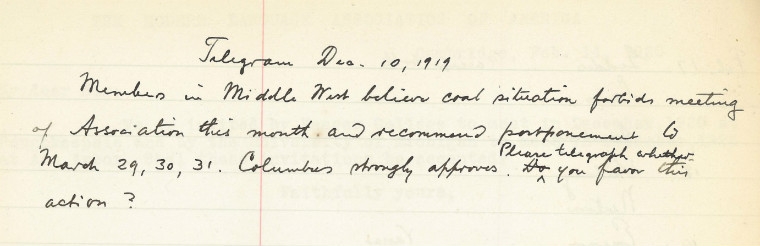
Telegram December 10, 1919
Members in the Middle West believe coal situation forbids meeting of Association this month and recommend postponement to March 29, 30, 31. Columbus strongly approves. Please telegraph whether you favor this action?
WWI and the Prohibition of German
“Now is the time to put a quietus on German pride . . .”
The New York Times, “To Strike Germany from Map of U.S.,” 2 June 1918
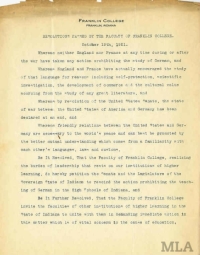
After World War I the teaching and speaking of German was banned at state and local levels throughout the United States. Some MLA members protested the ban and pointed to how other countries and universities approached the study of German in the wake of the war. MLA members W. G. Spencer and John C. Blankenagel submitted Franklin College’s resolution on teaching German to MLA executive director Carleton Brown. The resolution cited England and France as two countries that “encouraged the study of [German] for reasons including self-protection, scientific investigation, the development of commerce, and the cultural value accruing from the study of any great literature . . .”
World War II

“Aux armes, citoyens . . .”
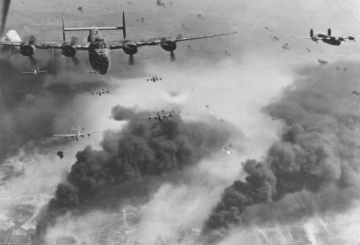
Executive Director Percy W. Long (1935–47) published an article titled “The Modern Language Association of America in World War II” in the March 1949 issue of PMLA. The article highlighted the many and unexpected ways in which the MLA membership had contributed to the war efforts. The newly appointed United States Secretary of Defense, Louis A. Johnson, noticed the article and sent a letter to the MLA saying, “May I ask that you extend to your membership the appreciation of the Department of Defense for their personal efforts during World War II, whether on the firing line, in intelligence and educational fields, or as citizens at home engaged in contributing to war activities.”
An Arresting Convention
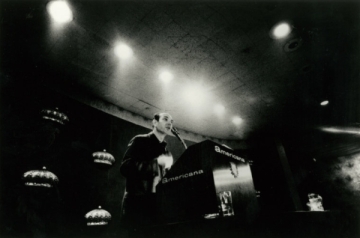
The 1968 MLA Annual Convention was a particularly memorable meeting, in part due to the arrest of Louis Kampf, then an associate professor of literature at MIT. Kampf was arrested for hanging posters in the Americana Hotel lobby for the radical New University Conference (NUC). The NUC’s newspaper described the scene as possessing “an atmosphere of hysteria.”
Kampf and the NUC movement were soon vindicated when Kampf was elected second vice president of the MLA for 1969, which led to his presidency in 1971.
No Chicago
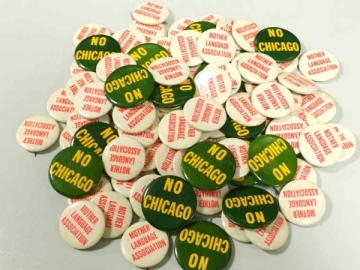
Many MLA members protested the location of the 1969 annual convention, originally scheduled to be held in Chicago. The discontent was due to Mayor Richard Daley’s management of the Democratic National Convention and police actions in the summer of 1968.
The controversy was resolved in February 1969 when the Executive Council changed the convention’s location to Denver, Colorado.