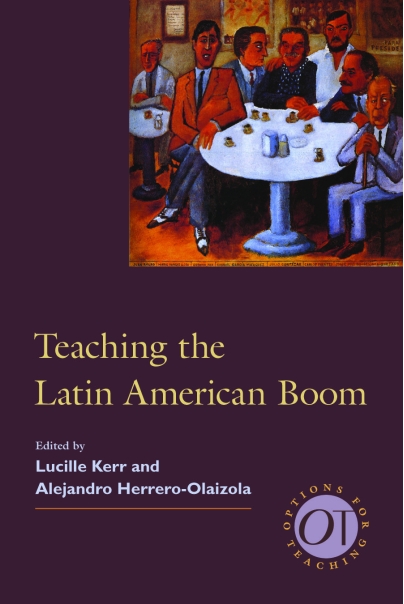
Teaching the Latin American Boom
- Editors: Lucille Kerr, Alejandro Herrero-Olaizola
- Pages: viii & 300 pp.
- Published: 2015
- ISBN: 9781603291910 (Hardcover)

“[A] great starting point for those who want to design a stimulating, provocative, innovative and interdisciplinary course on this subject.”
—Hispania
In the decade from the early 1960s to the early 1970s, Latin American authors found themselves writing for a new audience in both Latin America and Spain and in an ideologically charged climate as the Cold War found another focus in the Cuban Revolution. The writers who emerged in this energized cultural moment—among others, Julio Cortázar (Argentina), Guillermo Cabrera Infante (Cuba), José Donoso (Chile), Carlos Fuentes (Mexico), Gabriel García Márquez (Colombia), Manuel Puig (Argentina), and Mario Vargas Llosa (Peru)—experimented with narrative forms that sometimes bore a vexed relation to the changing political situations of Latin America.
This volume provides a wide range of options for teaching the complexities of the Boom, explores the influence of Boom works and authors, presents different frameworks for thinking about the Boom, proposes ways to approach it in the classroom, and provides resources for selecting materials for courses
Bruno Bosteels
César Braga-Pinto
Debra Castillo
Sara Castro-Klarén
Román de la Campa
Laura Demaría
Roberto Ignacio Díaz
David William Foster
Naomi Lindstrom
María Eugenia Mudrovcic
María Cristina Pons
Dierdra Reber
María Helena Rueda
Ignacio M. Sánchez Prado
Marcy Schwartz
Judith A. Weiss
Gareth Williams
Contents (v)
Introduction (1)
Part I: Framing the Boom
The Boom and Innovators of the Early Twentieth Century: Teaching the Interrelations (19)
Macho: Teaching Literary Histories of the Boom (27)
Lessons about the Writing Self and the Boom: Donoso, Fuentes, and Vargas Llosa (40)
Lessons for Reading around the Boom: New Narrative Trends and Traditions (50)
Part II: Texts and Contexts for the Boom Classroom
Teaching Arguedas (65)
Reading Fiction through Julio Cortázar: A Genealogy, a Theory for the Classroom (74)
Instructions for How to Teach the Boom in Julio Cortázar’s Rayuela (83)
Lessons of the Baroque in Guillermo Cabrera Infante’s Tres tristes tigres (96)
Literature and Redemption: Teaching Gabriel García Márquez’s No One Writes to the Colonel (107)
Part III: Disseminating the Boom
Teaching the Latin American Boom as World Literature (121)
Branding Latin America: An Introduction to Magical Realism (129)
Teaching Brazil and the Boom (137)
Clarice Lispector and the Latin American Bang (147)
Teaching Cuba and the Boom: Politics, Culture, and Literature in Casa de las Américas (162)
Names under Siege: Polemics in the Manufacturing of the Boom (172)
Part IV: Legacies of the Boom
The Boom and the Americas: A Story with No End (187)
From Macondo to McOndo: Tracing the Ideal of Latin American Literary Community from Magical Realism to Magical Neoliberalism (197)
The Boom and the New Historical Novel: Continuities and Ruptures (208)
Mediating the Boom: Teaching Latin American Literature through Film and YouTube (219)
Part V: Resources
Boom-Related Course Materials (233)
Notes on Contributors (263)
Works Cited (267)
Index (291)
“The attention to the framing of the Boom makes this volume more than just a study of the Boom; it stretches to cover a great deal of territory, literarily speaking, of twentieth- and twenty-first-century literature. This is a very important addition to the series.”
—Gwen Kirkpatrick, Georgetown University
“Teaching the Latin American Boom is especially recommended as a core addition to academic library Latin American Literature reference collections and supplement studies reading lists.”
—MBR Bookwatch
