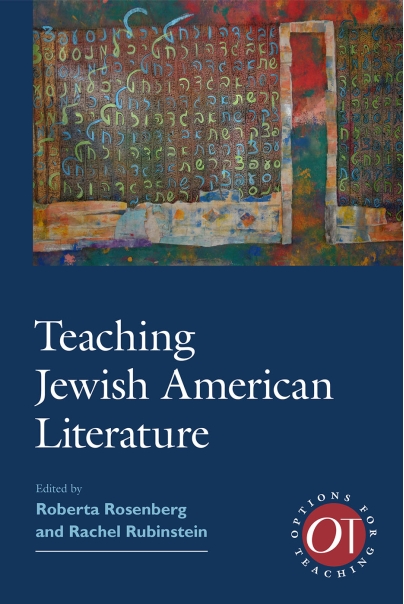
Teaching Jewish American Literature
- Editors: Roberta Rosenberg, Rachel Rubinstein
- Pages: 356
- Published: 2020
- ISBN: 9781603294454 (Paperback)
- ISBN: 9781603294720 (Hardcover)

“Highly recommended for academic libraries and any institutions that teach Jewish American literature.”
—Association of Jewish Libraries News and Reviews
A multilingual, transnational literary tradition, Jewish American writing has long explored questions of personal identity and national boundaries. These questions can engage students in literature, writing, or religion; at Jewish, Christian, or secular schools; and in or outside the United States.
This volume takes an expansive view of Jewish American literature, beginning with writing from the earliest colonies in the Americas and continuing to contemporary Soviet-born authors in the United States, including works that engage deeply with religious concepts and others that embrace assimilation. It invites readers to rethink the nature of American multiculturalism, suggests pairings of Jewish American texts with other ethnic American literatures, and examines the workings of whiteness and privilege.
Contributors offer varied perspectives on classic texts such as Yekl, Bread Givers, and “Goodbye, Columbus,” along with approaches to interdisciplinary topics including humor, graphic novels, and musical theater. The volume concludes with an extensive resources section.
Introduction (1)
Part I: Reframing Jewish American Histories, Rethinking Canons
Using Early Jewish American Literature to Teach about Race (23)
Expanding the Jewish American Literary Canon for Hebrew Day School Students (37)
Teaching Jewish American Literature with an Anthology (45)
Dismantling Christian Readings of Jewish American Literature in the Christian College: A. M. Klein’s The Second Scroll (58)
The Sense of Bashert: Contingency in Dara Horn’s The World to Come and Nicole Krauss’s History of Love (63)
Part II: Comparative Teaching Approaches
Jewish American Literature and the Multicultural Canon (73)
Team-Teaching Jewish and Caribbean Immigration Literature to Diverse Students in a State University (82)
Teaching Black-Jewish Literary Relations in Transnational Perspective (90)
Teaching Jewish American Children’s and Young Adult Literature (99)
Teaching with Things: The Clutter of Russian Jewish American Literature (108)
Teaching a Jewish and Arab American Literary Collaboration in Iraq (115)
Part III: Multilingual and Transnational Approaches
Unsettling the Linguistic and Geographical Borders of Jewish American Literature: Régine Robin’s La Québécoite (127)
Jews beyond America: The One and the Many (137)
American Poetry, Jewish Prayer, World Literature (144)
Beyond English: Language, Sound, and Voice in Jewish American Literature (153)
Postvernacular Ladino: Chameleon Languages and Translation Studies (163)
Sephardic Writing of the United States in a Comparative, Trans-American, and Transatlantic Frame (172)
Part IV: Gender and Sexuality Approaches
Writing New Kinds of Jews: A Course in Literary Genetics and Masculinity (183)
Gender, Genre, and Lesbian Identity in Four Modernist Jewish Texts (190)
Teaching Jewish American Women’s Writing (198)
Poetic Pedagogies: Teaching Irena Klepfisz in Israel/Palestine (208)
Jews, Gender, and Comix (216)
Teaching Angels in America in the Twenty-First Century: Memory, Mourning, and Meaning (231)
Part V: Multidisciplinary and Digital Humanities Approaches
Musical Theater as Literature: Art and Identity That Thrive on Change (241)
Serious Fun: Teaching Jewish American Humor (251)
Digital Jews: Questioning Borders in Jewish American Literature (258)
After the Golem: Teaching Golems, Kabbalah, Exile, Imagination, and Technological Takeover (267)
Teaching Contemporary Jewish American Holocaust Literature: Memory, “Fatigue,” and Narratives of Post-Holocaust Return (276)
Part VI: New Approaches and Key Texts
The Surprising Versatility of Israel Zangwill’s The Melting Pot (287)
Teaching Abraham Cahan’s Yekl as a Comedy of Arrival and Dislocation (296)
Displacement and Identity in the Work of Anzia Yezierska and Helena Maria Viramontes (304)
Teaching Anzia Yezierska’s Bread Givers in Australia (308)
Anzia Yezierska and the Changing Fortunes of Jewishness (312)
Four Approaches to Teaching “Goodbye, Columbus” (317)
Part VII: Resources
Resources (329)
Notes on Contributors (341)
“This volume extends the field of Jewish American literature well beyond its current boundaries and invites teachers and scholars to discover a wealth of pedagogical strategies and new texts.”
—Donald Weber, Mount Holyoke College
