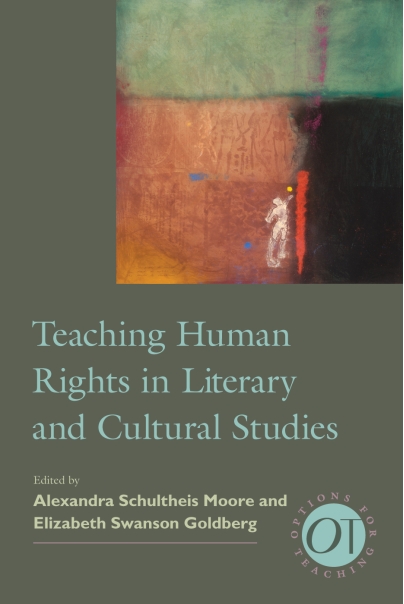
Teaching Human Rights in Literary and Cultural Studies
- Editors: Alexandra Schultheis Moore, Elizabeth Swanson Goldberg
- Pages: xii & 362 pp.
- Published: 2015
- ISBN: 9781603292153 (Hardcover)
- ISBN: 9781603292160 (Paperback)

“The time for human rights and literature has clearly come. In this field, Goldberg and Moore are among the most qualified to edit a volume for the MLA Options for Teaching series. The collection will help to expand thinking—and questions—about these interdisciplinary studies.”
—Domna Stanton, Graduate Center, City University of New York
Since the adoption of the Universal Declaration of Human Rights of 1948, the discourse of human rights has expanded to include not just civil and political rights but also economic, social, cultural, and, most recently, collective rights. Given their broad scope, human rights issues are useful touchstones in the humanities classroom and benefit from an interdisciplinary and cross-cultural pedagogy in which objects of study are situated in historical, legal, philosophical, literary, and rhetorical contexts. Teaching Human Rights in Literary and Cultural Studies is a sourcebook of inventive approaches and best practices for teachers looking to make human rights the focus of their undergraduate and graduate courses.
Contributors first explore what it means to be human and conceptual issues such as law and the state. Next, they approach human rights and related social-justice issues from the perspectives of particular geographic regions and historical eras, through the lens of genre, and in relation to specific rights violations—for example, storytelling and testimonio in Latin America or poetry created in the aftermath of the Armenian genocide. Essays then describe efforts to cultivate students’ capacity for ethical reading practices and to deepen their understanding of the stakes and artistic dimensions of human rights representations, drawing on active learning and experimental class contexts. The final section, on resources, directs readers to further readings in history, criticism, theory, and literary and visual studies and provides a chronology of human rights legal documents.
Marjorie Agosín
Ben Alberti
Elizabeth S. Anker
Karen Elizabeth Bishop
Jennifer Browdy de Hernandez
James Dawes
Ira Dworkin
Lisa Eck
Alexander Hartwiger
Wendy S. Hesford
Heather Hewett
Neville Hoad
Bridget Irish
Marike Janzen
Erik Juergensmeyer
Nicholas Matlin
Sophia A. McClennen
Greg A. Mullins
Kimberly A. Nance
Ryan Omizo
Crystal Parikh
Manav Ratti
Susan Spearey
Megan Sweeney
Brenda Carr Vellino
Belinda Walzer
Eve Wiederhold
Sarah Winter
Foreword (xi)
Introduction: Charting New Courses: Teaching Human Rights in Literary and Cultural Studies (1)
Part I: Issues and Definitions
Introduction (13)
Losses of Human Rights in the Literature Classroom (15)
Human Rights and the Tautology of Human Being (27)
Teaching the Legal Imperialism Debate over Human Rights (39)
Human Rights Cultures and Traditions: Beyond the Post-/Colonial and the West (53)
Part II: Historical and Geographic Orientations
Introduction (67)
On the History of Human Rights before 1948 (70)
Mapping African American Literature and Human Rights (86)
Representing China and Asia: Translating Outside in the Rights Machine (96)
Between Official Stories and Coerced Confessions: Testimonio and Storytelling in Latin America (108)
Revisiting The Visitor: Rhetoric, Ethics, and Feminist Models of Interpretation (123)
Part III: Bearing Wrongs, Reading Rights, Engendering Responsibility
Introduction (139)
Linking Economic Justice and Women’s Human Rights: Feminist Approaches for the Human Rights Literature Classroom (143)
Engaging the Literature and Film of Female Genital Mutilation in the Undergraduate Classroom (157)
Sexual Orientation and Human Rights: Walking with Shadows in Nigeria (168)
On Teaching the Close Reading of Torture Literature: An Approximation (178)
Cultivating the Translocal Citizen Witness: Contemporary Human Rights Poetry as “Remembrance/Pedagogy” (189)
Reconstituting Community, Identity, and Belonging: Classroom Encounters with Postconflict Texts (200)
Part IV: Classroom Contexts
Introduction (215)
Empirical Ethics, Theoretical Mechanics: Toward a Prosaics of Teaching Human Rights Literature (218)
Locating Difference: Addressing Student Expectations in the Human Rights and Literature Classroom (227)
Rhetorical Approaches to Teaching Human Rights: The Pedagogy of Speak Truth to Power (236)
Cultivating the Dialogic Subject of Human Rights Pedagogy (247)
Teaching Human Rights in the Composition Classroom: Engaging Students through Common Curricula (263)
Reading Culture and Writing Rights (273)
Experiencing Form: Service Learning in the Literature of Human Rights Classroom (284)
The Rickety Bridge: Prisoners and Human Rights in the Literature Classroom (294)
Part V: Resources
Resources (307)
Afterword: Human Rights Formalism (321)
Notes on Contributors (327)
Works Cited (333)
Index (357)
