Options for Teaching
There are 56 products in Options for Teaching
Teaching North American Environmental Literature
From stories about Los Angeles freeways to slave narratives to science fiction, environmental literature encompasses more than nature writing. The study of environmental narrative has flourished since the MLA published Teaching Environmental Literature in 1985. Today, writers evince a self-consciousness about writing in the genre, teachers have incorporated field study into courses, technology has opened up classroom possibilities, and institutions have developed to support study of this vital body of writing. The challenge for instructors is to identify core texts while maintaining the field’s dynamic, open qualities.
The essays in this volume focus on North American environmental writing, presenting teachers with background on environmental justice issues, ecocriticism, and ecofeminism. Contributors consider the various disciplines that have shaped the field, including African American, American Indian, Canadian, and Chicana/o literature. The interdisciplinary approaches recommended treat the theme of predators in literature, ecology and ethics, conservation, and film. A focus on place-based literature explores how students can physically engage with the environment as they study literature. The volume closes with an annotated resource guide organized by subject matter.
Teaching Oral Traditions
Research is beginning to unearth the astounding wealth of oral traditions that have served as a vital cultural activity and verbal art for peoples throughout the world, from antiquity to the present. In this thirteenth volume of the MLA series Options for Teaching, forty-two scholar-teachers bring these discoveries and rediscoveries from the scholarly forum to the classroom.
The essays in this exciting field touch on more than a hundred traditions and draw from the methodologies of literary studies, folklore, anthropology, and linguistics. They are filled with vivid specifics. Among the subjects discussed are the unwritten roots of the Bible; the genesis and art of the Homeric poems; Native American traditions, like the Zuni “Deer Boy” tale and the Quechua proverb “Corn-Planting Day”; the performance of the African American toast “Stagolee”; Old English charms for afflictions; Mexican American corridos; the Travelling People of Scotland; African trickster tales; women’s songs of mid-eleventh-century Andalusia; a Yiddish picaresque narrative; the fifth-century Indian Tale of an Anklet; South Slavic epics; the oral traditions behind Beowulf and behind the Canterbury Tales; the professional entertainers (jongleurs) of medieval France; and Icelandic sagas.
Teaching Oral Traditions demonstrates the importance of performance and challenges many current assumptions about the authority of the written word.
Teaching Postcolonial Environmental Literature and Media
Taking up the idea that teaching is a political act, this collection of essays reflects on recent trends in ecocriticism and the implications for pedagogy. Focusing on a diverse set of literature and media, the book also provides background on historical and theoretical issues that animate the field of postcolonial ecocriticism. The scope is broad, encompassing not only the Global South but also parts of the Global North that have been subject to environmental degradation as a result of colonial practices. Considering both the climate crisis and the crisis in the humanities, the volume navigates theoretical resources, contextual scaffolding, classroom activities, assessment, and pedagogical possibilities and challenges. Essays are grounded in environmental justice and the project to decolonize the classroom, addressing works from Africa, New Zealand, Asia, and Latin America and issues such as queer ecofeminism, disability, Latinx literary production, animal studies, interdisciplinarity, and working with environmental justice organizations.

Teaching Postwar Japanese Fiction
As Japan moved from the devastation of 1945 to the economic security that survived even the boom and bust of the 1980s and 1990s, its literature came to embrace new subjects and styles and to reflect on the nation's changing relationship to other Asian countries and to the West. This volume will help instructors introduce students to novels, short stories, and manga that confront postwar Japanese experiences, including the suffering caused by the atomic bombings of Hiroshima and Nagasaki, the echoes of Japan's colonialism and imperialism, new ways of thinking about Japanese identity and about minorities such as the zainichi Koreans, changes in family structures, and environmental disasters. Essays provide context for understanding the particularity of postwar Japanese literature, its place in world literature, and its connections to the Japanese past.
Teaching the Representation of the Holocaust
“Can the story be told?” Jorge Semprun asked after his liberation from Buchenwald. The question is addressed from many angles in this volume of essays on teaching about the Holocaust. In their introduction, Marianne Hirsch and Irene Kacandes argue that Semprun’s question is as vital now, and as difficult and complex, as it was for the survivors in 1945.
The thirty-eight contributors to Teaching the Representation of the Holocaust come from various disciplines (history, literary criticism, psychology, film studies) and address a wide range of issues pertinent to the teaching of a subject that many teachers and students feel is an essential part of a liberal arts education.
This volume offers approaches to such works as Jurek Becker’s Jacob the Liar, Roberto Benigni’s Life Is Beautiful, Anne Frank’s diary, Daniel Jonah Goldhagen’s Hitler’s Willing Executioners, Claude Lanzmann’s Shoah, Primo Levi’s Survival in Auschwitz, Cynthia Ozick’s The Shawl, Dan Pagis’s “Written in Pencil in the Sealed Railway Car,” Art Spiegelman’s Maus, Steven Spielberg’s Schindler’s List, Elie Wiesel’s Night, and Abraham Yehoshua’s Mr. Mani.
To the challenge “How do we transmit so hurtful an image of our own species without killing hope and breeding indifference?” posed by Geoffrey Hartman in this volume, the editors respond, “Only in the very human context of classroom interaction can we hope to avoid either false redemption or unending despair.”
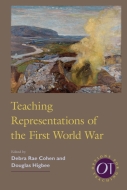
Teaching Representations of the First World War
The First World War was a conflict of unprecedented proportions that saw staggering loss of life. The catalyst for huge political and social changes, the war was in part shaped through propaganda, film, photography, poetry, memoir, and music. These artistic realms, in turn, influenced gender roles, the fate of empires, extreme political movements, and new aesthetic formations.
The volume’s scope reflects the vibrancy of today’s instructors as they contend with the many issues critical for teaching the First World War in a variety of classroom settings, including
- critical paradigms used in thinking about the war, such as its relation to modernism
- the global reach of the war’s representations, including the Middle East and South Asia
- cultural motifs connected to the war, from psychiatry, pacifism, and consumer culture to the 1918 influenza pandemic
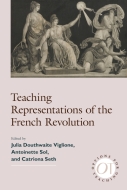
Teaching Representations of the French Revolution
In many ways the French Revolution—a series of revolutions, in fact, whose end has arguably not yet arrived—is modernity in action. Beginning in reform, it blossomed into wholesale attempts to remake society, uprooting the clergy and aristocracy, valorizing mass movements, and setting secular ideologies, including nationalism, in motion. Unusually manifold and complicated, the revolution affords many teaching opportunities and challenges. This volume helps instructors seeking to connect developments today—terrorism, propaganda, extremism—with the events that began in 1789, contextualizing for students a world that seems always unmoored and in crisis.
The volume supports the teaching of the revolution’s ongoing project across geographic areas (from Haiti, Latin America, and New Orleans to Spain, Germany, and Greece), governing ideologies (human rights, secularism, liberty), and literatures (from well-known to newly rediscovered texts). Interdisciplinary, intercultural, and insurgent, the volume has an energy that reflects its subject.
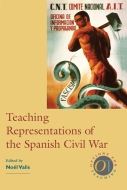
Teaching Representations of the Spanish Civil War
The Spanish Civil War (1936–39), a national conflict with international significance, inspired strong responses from artists and writers on both sides of the Atlantic. The bombing of the Basque town Guernica, the assassination of the poet Federico García Lorca, and the defense of Madrid are just some of the events represented in painting, film, fiction, memoir, and history produced during the war years and since.
Courses dealing with the Spanish Civil War are given regularly in literature, foreign language, and history departments, in English and in Spanish. This volume in the MLA series Options for Teaching helps instructors plan courses that exploit the interdisciplinary, multigeneric opportunities present in the period’s aesthetic output.
In thirty-five essays, contributors negotiate the complex relation between art and history in depictions of the war and its aftermath, exploring how memory is shaped. Key representations of the war, like Picasso’s Guernica, Hemingway’s For Whom the Bell Tolls, Orwell’s Homage to Catalonia, Rodoreda’s La plaça del Diamant, Sender’s Réquiem por un campesino español, and Capa’s Falling Militiaman, find a place in this wide-ranging volume. In addition, coverage extends to less frequently taught works by Catalan, German, Irish, and Latin American novelists, poets, and visual artists. The volume concludes with a section of resources for further study and classroom use, including films, music, photography, Web sites, and course syllabi and commentaries.
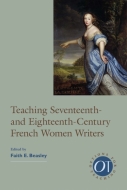
Teaching Seventeenth- and Eighteenth-Century French Women Writers
Seventeenth- and eighteenth-century France has been celebrated as the period of conversation. Salons flourished and became an important social force. Women and men worked together, in dialogue with their contemporaries, other texts, and their culture to create novels, political satire, drama, poetry, fairy tales, travel narratives, and philosophy. Yet the inclusion of women’s contributions, only recently recovered, changes the way we conceive of the period that constitutes one of the building blocks of French national identity and Western civilization, and teachers are often unsure how and where to incorporate the texts into their courses. Teaching Seventeenth- and Eighteenth-Century French Women Writers attempts to reconstruct these conversations by integrating women’s work into classrooms across the curriculum.
The works of French women writers are crucial to courses on the early modern period and enliven many others—whether on literature, history, women’s history, the history of science, philosophy, women’s and gender studies, or European civilization. The essays included in part 1 provide necessary background and help instructors identify places in their courses that could be enriched by taking women’s participation into account. Contributors in part 2 focus on some of the central writers and genres of the period, including Lafayette, Charrière, and Graffigny, the epistolary novel, convent writing, and memoirs. The essays in part 3 offer concrete descriptions of courses that place women’s texts in dialogue with those of their male colleagues or with historical issues.
Teaching Shakespeare through Performance
Performance pedagogy does more than involve students in the acting, directing, and production work needed to bring a play text to life. It engages them in interpretation; it makes issues of structure or subtext immediate; it deepens understanding of stage history; in film, it demonstrates the role of camera, lighting, sound.
Teaching Shakespeare through Performance is designed for teachers of both high school and college English courses who wish to introduce performance strategies into their classroom. The volume illustrates how attention to theatrical detail can give insight into Shakespeare’s work and world: the significance of an omitted exit or entrance, the role of stage directions in King Lear, costumes and transvestism on the Renaissance stage, the changing fashions of acting Juliet, how experimenting with the use of different personal props in a scene from Hamlet reveals cultural attitudes, and much more.
