Options for Teaching
There are 56 products in Options for Teaching
Teaching Anglophone Caribbean Literature
This volume in the Options for Teaching series recognizes that the most challenging aspect of introducing students to anglophone Caribbean literature—the sheer variety of intellectual and artistic traditions in Western and non-Western cultures that relate to it—also offers the greatest opportunities to teachers. Courses on anglophone literature in the Caribbean can consider the region’s specific histories and contexts even as they explore common issues: the legacies of slavery, colonialism, and colonial education; nationalism; exile and migration; identity and hybridity; class and racial conflict; gender and sexuality; religion and ritual. While considering how the availability of materials shapes syllabi, this volume recommends print, digital, and visual resources for teaching.
The essays examine a host of topics, including the following:
- the development of multiethnic populations in the Caribbean and the role of various creole languages in the literature
- oral art forms, such as dub poetry and reggae music
- the influence of anglophone literature in the Caribbean on literary movements outside it, such as the Harlem Renaissance and black British writing
- Carnival
- religious rituals and beliefs
- specific genres such as slave narratives and autobiography
- film and drama
- the economics of rum
Many essays list resources for further reading, and the volume concludes with a section of additional teaching resources.
Teaching Film
Film studies has been a part of higher education curricula in the United States almost since the development of the medium. Although the study of film is dispersed across a range of academic departments, programs, and scholarly organizations, film studies has come to be recognized as a field in its own right. In an era when teaching and scholarship are increasingly interdisciplinary, film studies continues to expand and thrive, attracting new scholars and fresh ideas, direction, and research.
Given the dynamism of the field, experienced and beginning instructors alike need resources for bringing the study of film into the classroom. This volume will help instructors conceptualize contemporary film studies in pedagogical terms. The first part of the volume features essays on theory and on representation, including gender, race, and sexuality. Contributors then examine the geographies of cinema and offer practical suggestions for structuring courses on national, regional, and transnational film. Several essays focus on interdisciplinary approaches, while others describe courses designed around genre (film noir, the musical), mode (animation, documentary, avant-garde film), or the formal elements of film, such as sound, music, and mise-en-scène. The volume closes with a section on film and media in the digital age, in which contributors discuss the opportunities and challenges presented by access to resources, media convergence, and technological developments in the field.
Teaching Seventeenth- and Eighteenth-Century French Women Writers
Seventeenth- and eighteenth-century France has been celebrated as the period of conversation. Salons flourished and became an important social force. Women and men worked together, in dialogue with their contemporaries, other texts, and their culture to create novels, political satire, drama, poetry, fairy tales, travel narratives, and philosophy. Yet the inclusion of women’s contributions, only recently recovered, changes the way we conceive of the period that constitutes one of the building blocks of French national identity and Western civilization, and teachers are often unsure how and where to incorporate the texts into their courses. Teaching Seventeenth- and Eighteenth-Century French Women Writers attempts to reconstruct these conversations by integrating women’s work into classrooms across the curriculum.
The works of French women writers are crucial to courses on the early modern period and enliven many others—whether on literature, history, women’s history, the history of science, philosophy, women’s and gender studies, or European civilization. The essays included in part 1 provide necessary background and help instructors identify places in their courses that could be enriched by taking women’s participation into account. Contributors in part 2 focus on some of the central writers and genres of the period, including Lafayette, Charrière, and Graffigny, the epistolary novel, convent writing, and memoirs. The essays in part 3 offer concrete descriptions of courses that place women’s texts in dialogue with those of their male colleagues or with historical issues.
Teaching French Women Writers of the Renaissance and Reformation
Teaching French Women Writers of the Renaissance and Reformation considers the issues critical to teaching recently rediscovered writers, such as Hélisenne de Crenne, Pernette Du Guillet, and Louise Labé, who have enriched the literary canon by offering alternative perspectives on the social, political, and religious issues of early modern France. Addressing topics from law and medicine to motherhood and aesthetics, these women wrote in nearly every genre, and their works include several literary firsts: the first book of Christian emblems ever published by a woman (Georgette de Montenay), the first published collection of private letters between women in French (the Dames Des Roches), and the first full-length memoir by a woman in French (Margaret of Valois).
The volume considers techniques for reading women’s writing alongside the texts of their male contemporaries and offers guidance on incorporating a range of resources into the classroom. Essays in part 1 explore the background and contexts so crucial for helping students understand how these writers negotiated their entry into the public world of writing. In part 2, contributors discuss specific genres. Part 3 describes critical methodologies that are useful in the classroom and demonstrates the benefits of teaching certain pairings of texts and authors. The fourth and final part recommends a range of electronic and print resources.
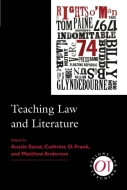
Teaching Law and Literature
This volume provides a resource for teachers interested in learning about the field of law and literature and shows how to bring its insights to bear in their classrooms, both in the liberal arts and in law schools. Essays in the first section, “Theory and History of the Movement,” provide a retrospective of the field and look forward to new developments. The second section, “Model Courses,” offers readers an array of possibilities for structuring courses that integrate legal issues with the study of literature, from The Canterbury Tales to current prison literature. In “Texts,” the third section, guidance is provided for teaching not only written documents (novels, plays, trial reports) but also cultural objects: digital media, Native American ceremonies, documentary theater, hip-hop. The volume’s contributors investigate what constitutes law and literature and how each informs the other.
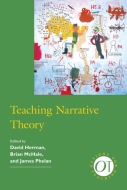
Teaching Narrative Theory
The last two decades have seen a burst of renewed interest in narrative theory across many academic disciplines as scholars analyze the power of storytelling in print and other media. Teaching Narrative Theory provides a comprehensive resource for instructors who aim to help students identify and understand the distinctive features of narrativity in a text or discourse and make use of the terms and concepts of the field.
This volume in the Options for Teaching series is organized to assist teachers at different levels of instruction and in different disciplinary settings. In twenty-one essays, the contributors discuss narrative theory’s various teaching contexts (e.g., classes on literature, creative writing, and folklore and ethnography); key concepts and terms (e.g., story and plot, time and space, voice, perspective); applications beyond printed texts (e.g., film and digital media); and impact on other areas of theory (e.g., gender and ethnic studies). A glossary provides a guide to the challenging technical terminology characteristic of the field, and the volume as a whole emphasizes the importance of understanding and implementing technical terms in learning narrative theory.
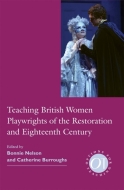
Teaching British Women Playwrights of the Restoration and Eighteenth Century
The considerable contributions of British women playwrights of the Restoration and eighteenth century, long unavailable, have now inspired numerous anthologies, editions, and modern-day productions. As these works continue to gain recognition and secure a more prominent place in college curriculums, teachers face the challenge of introducing these rediscovered works to students and explaining how they fit into the period’s dramatic tradition. This volume aims to help instructors present a clearer sense of this body of work in the undergraduate and graduate classroom.
The volume opens with background essays on the history of women in theater, including the first appearance of actresses on the stage, the earliest professional women playwrights, and their relationships with critics, audiences, and the theater manager David Garrick. Contributors then focus on individual playwrights, from Aphra Behn and Mary Pix to Hannah Cowley and Elizabeth Inchbald, and explore these women’s political, protofeminist, critical, and moralist agendas. Discussions of Frances Burney and Eliza Haywood, authors of both novels and plays, raise the question of genre. Comparative approaches offer ways of pairing plays in the classroom, following themes such as masquerade and cross-dressing through the works of female dramatists and those of their male counterparts. Other essays present methods for using these writers and their works in British literature and history courses, surveys of drama and theater history, and introductions to women’s literature.
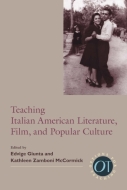
Teaching Italian American Literature, Film, and Popular Culture
Italian American studies has long been in conversation with American culture at large and is increasingly present in American universities and colleges. Yet once-celebrated works, such as Pietro di Donato’s Christ in Concrete, have slipped from the public consciousness, and many scholars fear that representations of Italian Americans in popular culture, as in The Godfather films and the television series The Sopranos, have obscured genuine historical inquiry and understanding. This volume aims to foster a deeper and more complex appreciation for the importance of Italian American texts in the study of American culture.
The editors open the volume by outlining the history of Italians in the United States and exploring the potential of literature and the arts to enable the recovery of a forgotten, even repressed, historical past. Over thirty scholars and teachers then present innovative ways of teaching Italian American texts and integrating them with other texts in courses ranging from American literature and history to multiethnic and women’s studies. Contributors discuss Italian American fiction, poetry, memoir, oral history, and theater and performance. A section on film and television provides an overview of popular as well as lesser-known works and interrogates the stereotyped portrayals of Italian Americans. Other contributors offer historical and interdisciplinary approaches to Italian American texts that revolve around themes of race and gender politics, work and social class, and historical intersections. The volume concludes with a review of anthologies that can be used in teaching Italian American studies.
Teaching Early Modern English Prose
To gain a full understanding of the literature and history of early modern England, students need to study the prose of the period. Aiming to make early modern prose more visible to teachers, this volume approaches prose as a genre that requires as much analysis and attention as the drama and poetry of the time. The essays collected here consider the broad cultural questions raised by prose and explore prose style, showing teachers how to hone students’ writing skills in the process.
Noting that the inclusion of Renaissance prose in anthologies now makes it easier to teach texts discussed in this volume, the introduction considers the practical and historical reasons prose has been taught less often than poetry and drama. The essays call attention to the range of prose writing and to the variety of definitions that have been developed to describe it. In part 1, contributors outline broad issues concerning early modern prose, looking at rhetoric and pamphlet writing and asking how to classify nonfiction. Essays in part 2 discuss particular genres, such as sermons, martyrologies, autobiographies, and Quaker writings. The third part explores specific prose works, including Francis Bacon’s scientific writing, Richard Hooker’s prose, and the transcribed speeches of Queen Elizabeth I. The final part, “Crossings and Pairings,” examines ways to use prose in teaching early modern attitudes toward issues such as education, imperialism, and the translation of the Bible.
Teaching the Graphic Novel
Graphic novels are now appearing in a great variety of courses: composition, literature, drama, popular culture, travel, art, translation. The thirty-four essays in this volume explore issues that the new art form has posed for teachers at the university level. Among the subjects addressed are
- terminology (graphic narrative vs. sequential art, comics vs. comix)
- the three outstanding comics-producing cultures today: the American, the Japanese (manga), and the Franco-Belgian (the bande dessinée)
- the differences between the techniques of graphic narrative and prose narrative,and between the reading patterns for each
- the connections between the graphic novel and film
- the lives of the new genre’s practitioners (e.g., Robert Crumb, Harvey Pekar)
- women’s contributions to the field (e.g., Lynda Barry)
- how the graphic novel has been used to probe difficult moments in history (the Holocaust, 9/11), deal with social and racial injustice, and voice political satire
- postmodernism in the graphic novel (e.g., in the work of Chris Ware)
- how the American superhero developed in the Depression and World War II
- comix and the 1960s counterculture
- the challenges of teaching graphic novels that contain violence and sexual content
The volume concludes with a selected bibliography of the graphic novel and sequential art.
