Notable Figures
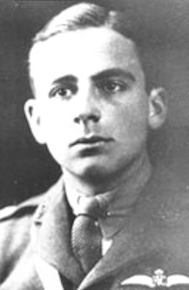

Mr. Magoo, War Hero and Bibliographer
In 1929 the MLA International Bibliography introduced the new category of general literature, which was to precede American literature in the print volume. The first general-literature editor was Francis Peabody Magoun (1929–31), an American-born citizen who had claimed to be Canadian in order to join the British Royal Air Force as a lieutenant in World War I. He took down five enemy aircraft, was wounded, and received the Military Cross in 1918 for “conspicuous gallantry and devotion to duty.”[1]
After the war, Magoun became a professor of comparative literature and English at Harvard University, where he was a notable character on campus. Many believe that Professor Magoun may have been the inspiration for the cartoon character Mr. Magoo.
[1] Supplement to the London Gazette, 22 June 1918.
Lead Belly Plays the Annual Convention
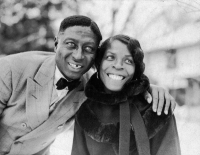
In 1933 the renowned musician Huddie William Ledbetter, known as Lead Belly, played guitar and sang for convention attendees, bringing to life John A. Lomax’s presentation on folksongs and ballads.
Lead Belly performed for the MLA membership on 28 December at the evening “smoker” and again the next morning for the Popular Literature section. Though no recording of these performances was made, Lomax created an impressive collection of audio and video recordings of Lead Belly’s music. In 2011, a radio station uncovered this recording of Lomax’s son Alan, a folklorist, performing with Lead Belly at the 1944 American Music Festival.
Reverend Carleton Brown
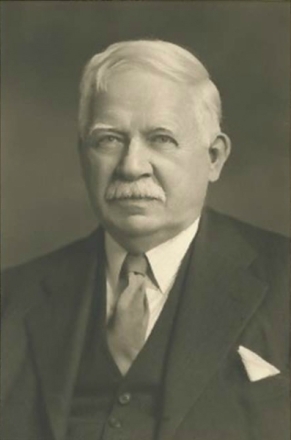
Carleton Brown, the fifth executive director of the MLA (1920–34) and its forty-sixth president (1936), was an ordained minister. He married Rossell Hope Robbins, a Middle English scholar, to Helen Ann Mins on 9 July 1939 at the MLA headquarters in the South Building on Washington Square.
Why host a wedding at the MLA?
“We thought that as a City Hall ceremony lacks dignity, we would avail ourselves of the status of my teacher and friend. Carleton Brown had been ordained a Unitarian minister—a fact not commonly known—but had served very little; he had never performed a marriage, and so had to go to considerable trouble to get licensed: documentation from his home church in Boston and then registration by New York State. . . .
“It was a very simple ceremony. . . . For the first time—and the last—the long table, normally hidden under a two-foot cloak of books, pamphlets, loose papers and envelopes, had been cleared, and was decorated with a vase of yellow iris, which Carleton Brown had brought in from his garden.”
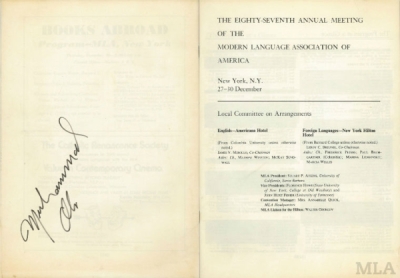
Muhammad Ali Attends the Convention
In the fall of 2016 the MLA received a one-of-a-kind gift “in honor of Rosemary G. Feal, who has done so much to transform the MLA in her years as its Executive Director”: an MLA annual convention program signed by Muhammad Ali. The program was donated along with a story from MLA member Bonnie Wheeler, who described the event, saying:
Imagine the sight of an MLA convention in New York in December of 1972. Late one afternoon I was waiting for a friend in the jammed Hilton Hotel lobby, surrounded by dozens of other literature professors (almost all men, with the usual cigarettes and pipes) from around the country. Suddenly a large man with a big male entourage said, “hello.” He was one of the most recognizable and admired men in the world at the time. “Muhammad Ali, how nice to meet you,” I replied and put out my hand to shake his. . . . Some of my proudly athletic and distinguished Columbia colleagues emerged from an elevator and honed (sic) in on this cultural icon. “I’d like you to meet some guys who teach English with me at Columbia,” I said, to which he replied, after an extended pause, in wide-eyed amazement, “You mean BOYS teach English?”
Executive Secretary vs. Executive Director
Since the MLA’s formation during the snowy December of 1883, fourteen executive directors have governed the association. Originally secretary, or executive secretary, the title was changed to executive director in 1974 during William D. Schaefer’s term.
Eight of the fourteen executive directors have also served as MLA presidents: A. Marshall Elliott, James W. Bright, Charles H. Grandgent, Carlton Brown, Percy W. Long, William R. Parker, George W. Stone, and John H. Fisher.
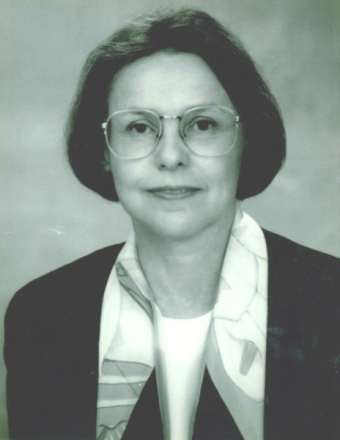
The longest serving executive director was also the first woman to hold the position, Phyllis Franklin, who served from 1985 to 2002. Peter Brooks, an MLA member for over fifty years, described Franklin as possessing an “enormous tenacity and great diplomacy.”
Four executive directors—A. Marshall Elliott, James W. Bright, Charles H. Grandgent, and Carleton Brown—led the MLA without an official association headquarters. Eight years into his term, Brown opened the doors to the MLA’s first headquarters, on NYU’s campus in the South Building on the southeastern corner of Washington Square.