Nonseries
There are 70 products in Nonseries
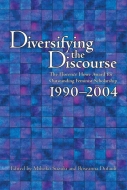
Diversifying the Discourse
The Florence Howe Award for Outstanding Feminist Scholarship, created in 1974, has played a major role in establishing the legitimacy and visibility of feminist inquiry. The early award-winning essays are available in the MLA volume Courage and Tools. This volume presents the seventeen essays that won the award for the years 1990–2004, an era that witnessed a diversification of the objects of feminist study and critical approaches. Essays treat authors ranging from well-known writers such as Jane Austen, Charlotte Brontë, Gwendolyn Brooks, Doris Lessing, and Virginia Woolf to less familiar writers such as the Magreb author Assia Djebar, the Spanish poet Concha Méndez, the Native American writer Zitkala-Sa, and the Palestinian novelists Liana Badr and Sahar Khalifeh. Essayists explore their topics through a multiplicity of perspectives, including race and ethnicity studies, cultural studies, psychoanalysis and film theory, nationhood and nationalism, and discourses of aging. Each award winner has written a short afterword, reflecting on her essay and her critical practice.
The volume includes a foreword by Florence Howe, cofounder of the Feminist Press, and an afterword by Annette Kolodny, an early recipient of the Florence Howe award.
Double Minorities of Spain
Double Minorities of Spain contains valuable biographical and bibliographic information on an important group of Hispanic writers heretofore excluded from or underrepresented in traditional Spanish literary histories and bibliographic resources.
The volume identifies nearly 500 authors—421 Catalans, 31 Galicians, and 20 Basques—ranging from the medieval nuns who composed Les Malmonjades to women writing today. Alphabetically arranged listings provide brief biographies and general descriptions of the works, followed by bibliographic sections with up to four subsections: listings of books; isolated publications in books, periodicals, and newspapers; works translated into Castilian or English; and critical studies. Bibliographies include works by the authors written in other languages. An appendix lists the writers chronologically by date of birth.
Double Minorities is an essential guide for teachers and scholars of Hispanic culture and for research libraries with collections in literature.
Electronic Textual Editing
The long history of textual editing and scholarship has been intimately involved with the physique of the book, which set limits on the presentation and study of text. Increasingly, since the 1980s, the written word has taken on a digital form, and the shift from codex to computer, from print to electronic media, creates new opportunities—and new difficulties.
This volume offers an emerging consensus about the fundamental issues of electronic textual editing. It provides practical advice and faces theoretical questions. Its twenty-four essays deal with markup coding and procedures, electronic archive administration, use of standards (such as Unicode), rights and permissions, and the changing and challenging environment of the Internet. Some of the specific texts discussed are Greek and Latin inscriptions, the Gospel of John, the Canterbury Tales, William Blake’s poems and art, Percy Bysshe Shelley’s The Devil’s Walk, Stijn Streuvels’s De teleurgang van den Waterhoek, Ludwig Wittgenstein’s Nachlass, and the papers of Thomas Edison.
The guidelines of the MLA’s Committee on Scholarly Editions, recently revised to address electronic editions, are included in full.
German Studies in the United States
In the United States, German studies traces its beginnings to the late nineteenth century, when research universities were founded on the German model. The dominance of German as a foreign language before World War I and the decline in enrollments during that war are salient points in the discipline’s social history. Today German studies finds itself at a crossroads, facing unexpected change in the structure of higher education and in the cultural and economic support for studying language and literature.
Instead of taking a narrative or chronological approach, this volume foregrounds multiple, heterogeneous aspects of German as a discipline. They include
- the composition of the professoriat, employment patterns, the place of women
- the dramatic effects of World Wars I and II, and of the Soviet Sputnik success, on enrollments, jobs, and budgets
- the support—and indifference—of the large (once 4 million people) German American community
- the role of research universities, leading scholars, major books in the field
- the role of professional organizations, conferences, and journals
- the Americanization of German studies
- the role of Jewish scholars and of the Holocaust
- the fact of there having been two Germanys
German Studies in the United States is an important contribution to the history of higher education in this country.
Graduate Education for a Thriving Humanities Ecosystem
While the humanities remain as necessary as ever, the shrinking academic job market has led scholars to rethink the nature and purpose of graduate school in these fields. Highlighting examples of innovative approaches, this volume aims to provide resources and inspiration for a sustainable, thriving, and even joyful future for the humanities.
The essays in this collection offer a framework for doctoral education and postdoctoral careers rooted in concepts of abundance, collaboration, community engagement, and personal well-being. They emphasize the role of the humanities in helping people analyze texts, imagine others' perspectives, make ethical decisions, and sit with ambiguity. They propose graduate programs that respond to student and community needs and lead to a variety of career paths. Finally, they envision opportunities for meaningful, fulfilling work in the service of a larger purpose.
Guide to Reference Works for the Study of the Spanish Language and Literature and Spanish American Literature (2nd edition)
Woodbridge’s annotated bibliography has become the standard for graduate students seeking an introduction to Spanish language and literature studies and for librarians developing reference collections in the field. The second edition contains more than three hundred new entries and updates previous listings. An elaborate table of contents and three indexes will help researchers find needed resources quickly.
The volume selectively lists and describes 1,230 valuable and important reference works published since 1950, including bibliographies, dictionaries, glossaries, concordances, union lists, catalogs, manuals, research guides, and dissertations. A short section on bibliographies covering both literature and language is followed by sections on the Spanish of Spain, American Spanish, Spanish literature of Europe, and Spanish literature of the Western Hemisphere. The guide concludes with an index of authors, editors, compilers, and translators; an index of authors and anonymous works as subjects; and a title index.
Helping Students Write Well
Helping Students Write Well has become the standard manual for college instructors seeking to integrate writing into their courses more effectively. The book suggests techniques for responding to student work, guiding student peer groups, and dealing with specific writing problems. Aimed at college faculty members in a variety of disciplines—history, sociology, biology, marketing, psychology, literature, and others—Barbara Walvoord’s lively text provides methods for helping students
- generate ideas
- bring topics into focus
- gather and integrate library information
- organize reasoning and evidence
- follow a required format
- draft, revise, and edit
- improve style and mechanics
- compose visual aids
Unique to this edition are seven detailed case histories that describe how teachers in various disciplines have applied Walvoord’s techniques in actual courses.
Helping Students Write Well is an essential tool both for those who teach writing and for those who want to make writing a significant part of their courses.
How Students Write: A Linguistic Analysis
Broad generalizations about “people today” are a familiar feature of first-year student writing. How Students Write brings a fresh perspective to this perennial observation, using corpus linguistics techniques. This study analyzes sentence-level patterns in student writing to develop an understanding of how students present evidence, draw connections between ideas, relate to their readers, and, ultimately, learn to construct knowledge in their writing.
Drawing on both first-year and upper-level student writing, the book examines the discourse of students at different points in their education. It also distinguishes between argumentative and analytic essays to explore the way school genres and assignments shape students’ choices.
In focusing on sentence-level features such as hedges (“perhaps”) and boosters (“definitely”), this study shows how such rhetorical choices work together to open or close opportunities for thoughtful exchanges of ideas. Attention to these features can help instructors foster civil discourse, design effective assignments, and expose and question norms of higher education.
Improving Outcomes: Disciplinary Writing, Local Assessment, and the Aim of Fairness
Students thrive when they are exposed to a variety of disciplinary genres, and their lives—and our institutions—are enriched by improving their writing outcomes. Taking account of evolving research, writing in the disciplines, and demographic and institutional shifts in higher education, this volume imagines new ways to improve writing outcomes by broadening the focus of assessment to wider issues of humanity and society.
The essays—by contributors from diverse fields, from writing studies to nursing, engineering, and architecture—demonstrate innovative classroom practices and curricular design that place fairness and the situatedness of language at the center of writing instruction. Contributors reflect on a wide range of examples, from a disability-as-insight model to reckoning with postcolonial legacies, and the essays consider a variety of institutions, classrooms, and types of assessment, including culturally responsive assessment and peer feedback in digital environments.
