MLA Texts and Translations
There are 80 products in MLA Texts and Translations
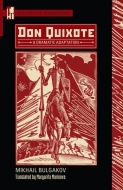
Don Quixote: A Dramatic Adaptation
When Soviet censors approved Mikhail Bulgakov’s stage adaptation of Don Quixote, they were unaware that they were sanctioning a subtle but powerful criticism of Stalinist rule. The author, whose novel The Master and Margarita would eventually bring him world renown, achieved this sleight of hand through a deft interpretation of Cervantes’s knight. Bulgakov’s Don Quixote fits comfortably into the nineteenth-century Russian tradition of idealistic, troubled intellectuals, but Quixote’s quest becomes an allegory of the artist under the strictures of Stalin’s regime. Bulgakov did not live to see the play performed: it went into production in 1940, only months after his death.
The volume’s introduction provides background for Bulgakov’s adaptation and compares Bulgakov with Cervantes and the twentieth-century Russian work with the seventeenth-century Spanish work.
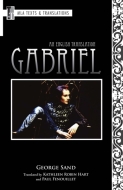
Gabriel: An English Translation
“An admirable ruse, indeed! To inspire in me the horror of females, only to throw it in my face and say: but this is what you are.”
The handsome, heroic heir to a vast estate, raised as a man to follow a man’s pursuits and to despise women, is devastated to learn at the age of seventeen that he is in fact a she. Gabriel courageously refuses to give up her male privileges, and her tragic struggle to work and fight and love in all the ways she knows how offers a window into the obstacles faced by George Sand, the prolific intellectual woman whom the popular press portrayed as a promiscuous, cigar-smoking oddity in trousers. “Strange that the most virile talent of our time should be a woman’s!” exclaimed a reviewer in 1838.
Kathleen Robin Hart’s introduction contextualizes the drama, discussing its relation to the theater of Sand’s day, the sentimental tradition, the subversive workings of carnival and masquerade, and the vein of literary androgyny in Romantic works.
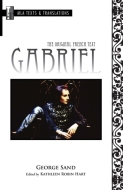
Gabriel: The Original French Text
“An admirable ruse, indeed! To inspire in me the horror of females, only to throw it in my face and say: but this is what you are.”
The handsome, heroic heir to a vast estate, raised as a man to follow a man’s pursuits and to despise women, is devastated to learn at the age of seventeen that he is in fact a she. Gabriel courageously refuses to give up her male privileges, and her tragic struggle to work and fight and love in all the ways she knows how offers a window into the obstacles faced by George Sand, the prolific intellectual woman whom the popular press portrayed as a promiscuous, cigar-smoking oddity in trousers. “Strange that the most virile talent of our time should be a woman’s!” exclaimed a reviewer in 1838.
Kathleen Robin Hart’s introduction contextualizes the drama, discussing its relation to the theater of Sand’s day, the sentimental tradition, the subversive workings of carnival and masquerade, and the vein of literary androgyny in Romantic works.
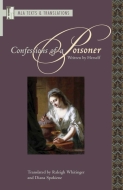
Confessions of a Poisoner, Written by Herself
In Berlin, 1803, readers rushed to their bookstores and libraries to learn more about Countess Charlotte Ursinus, who had murdered several people with poison and was now in prison. To their surprise, Confessions of a Poisoner, Written by Herself turned out to be not an account by this serial killer but a novel, its author anonymous and its pages filled with promiscuous sex, sharp social criticism, and dark humor.
In their introduction to the translation, Raleigh Whitinger and Diana Spokiene show how Confessions was written in response to a literary tradition (Richardson, Rousseau, Goethe) and how, in its questioning of the submissive images and roles of women, it anticipates feminist fiction of a century later. Whitinger and Spokiene also review the critical arguments about whether the author was a man or a woman.
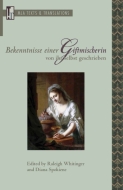
Bekenntnisse einer Giftmischerin, von ihr selbst geschrieben
In Berlin, 1803, readers rushed to their bookstores and libraries to learn more about Countess Charlotte Ursinus, who had murdered several people with poison and was now in prison. To their surprise, Confessions of a Poisoner, Written by Herself turned out to be not an account by this serial killer but a novel, its author anonymous and its pages filled with promiscuous sex, sharp social criticism, and dark humor.
In their introduction to the translation, Raleigh Whitinger and Diana Spokiene show how Confessions was written in response to a literary tradition (Richardson, Rousseau, Goethe) and how, in its questioning of the submissive images and roles of women, it anticipates feminist fiction of a century later. Whitinger and Spokiene also review the critical arguments about whether the author was a man or a woman.
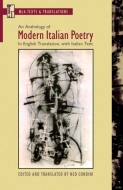
An Anthology of Modern Italian Poetry
Italian poetry of the last century is far from homogeneous: genres and movements have often been at odds with one another, engaging the economic, political, and social tensions of post-Unification Italy. The thirty-eight poets included in this anthology, some of whose poems are translated here for the first time, represent this literary diversity and competition: there are symbolists (Gabriele D’Annunzio), free-verse satirists (Gian Pietro Lucini), hermetic poets (Salvatore Quasimodo), feminist poets (Sibilla Aleramo), twilight poets (Sergio Corazzini), fragmentists (Camillo Sbarbaro), new lyricists (Eugenio Montale), neo-avant-gardists (Alfredo Giuliani), and neorealists (Pier Paolo Pasolini)—among many others.
Ned Condini was born in Turin, Italy; studied in Italy and England; and lives in North Carolina. He is the author of poetry, short stories, and novels. He won the Renato Poggioli Award from PEN American Center for his translation of Italian poetry.
The introduction and notes were provided by Dana Renga, assistant professor of Italian at Ohio State University.
Poets in the volume: Sibilla Aleramo, Carlo Betocchi, Dino Campana, Cristina Campo, Giorgio Caproni, Vincenzo Cardarelli, Sergio Corazzini, Gabriele D’Annunzio, Milo De Angelis, Luigi Fontanella, Franco Fortini, Alfredo Giuliani, Corrado Govoni, Guido Gozzano, Amalia Guglielminetti, Giorgio Guglielmino, Gian Pietro Lucini, Mario Luzi, Valerio Magrelli, Anna Malfaiera, Fausto Maria Martini, Eugenio Montale, Arturo Onofri, Aldo Palazzeschi, Alfredo de Palchi, Giovanni Pascoli, Pier Paolo Pasolini, Sandro Penna, Antonia Pozzi, Salvatore Quasimodo, Amelia Rosselli, Umberto Saba, Roberto Sanesi, Edoardo Sanguineti, Camillo Sbarbaro, Maria Luisa Spaziani, Giuseppe Ungaretti, Andrea Zanzotto
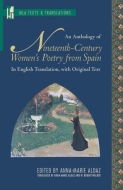
An Anthology of Nineteenth-Century Women’s Poetry from Spain
“The woman poet . . . must sing, just as birds fly and rivers flow,” wrote Carolina Coronado in 1846. In Spain of that time, a group of women had begun to publish poetry. Their verse—Romantic, predominantly lyric, and often linked to liberal reform—was novel and controversial, because few women had ventured into print. The poets collected in this anthology asserted in different ways their imagination and literary voice.
Susan Kirkpatrick provides an overview of the period, and Anna-Marie Aldaz adds a discussion of Spanish versification as well as biographical sketches of the twenty-one poets whose works bring alive the first decades of women’s emergence as a force in the Spanish literary world.
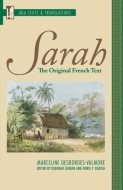
Sarah: The Original French Text
A dugout canoe comes ashore on the island of Saint-Barthélemy in the Antilles; in it are a black man, Arsène, and a sleeping white child, Sarah. Seeking refuge, they are taken in by a good man, but the overseer of his plantation threatens both Arsène and Sarah with the loss of their freedom.
Deborah Jenson and Doris Kadish introduce Sarah, an 1821 novella by Desbordes-Valmore, explaining its autobiographical background, political context (the revolt of blacks against Napoléon’s soldiers), and literary genre (sentimentalism). The novella was a precursor to anticolonial and antislavery texts by Claire de Duras, Victor Hugo, George Sand, and Alphonse de Lamartine.
Marceline Desbordes-Valmore (1786–1859), born in an artisan’s family, was poor much of her life. Her arrival with her mother in the French Caribbean coincided with the outbreak of rebellion among the black population. After her mother’s death, Desbordes-Valmore returned to Europe, where she worked as an actress and eventually made her name as a Romantic poet.
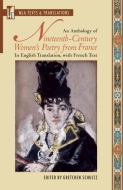
An Anthology of Nineteenth-Century Women’s Poetry from France
Women poets in nineteenth-century France made important contributions to major stylistic innovations—from the birth of elegiac Romanticism to the inauguration of free verse—and many were prominent in their lifetime, yet only a few are known today, and nearly all have been unavailable in English translation. Of the fourteen poets of this anthology some were wealthy, others struggled in poverty; some were socially conventional, others were cynical or defiant. Their poems range widely in style and idea, from Romantic to Parnassian to symbolist.
Gretchen Schultz, author of The Gendered Lyric: Subjectivity and Difference in Nineteenth-Century French Poetry, provides literary history and biographical notes to show the crucial role women played in nineteenth-century French poetry and to explain why they were criticized and—in the creation of the canon—often eclipsed.
The translators are Anne Atik, Michael Bishop, Mary Ann Caws, Melanie Hawthorne, J. S. A. Lowe, Rosemary Lloyd, Laurence Porter, Christopher Rivers, Gretchen Schultz, Patricia Terry, and Rosanna Warren.
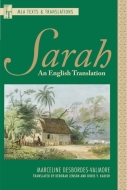
Sarah: An English Translation
A dugout canoe comes ashore on the island of Saint-Barthélemy in the Antilles; in it are a black man, Arsène, and a sleeping white child, Sarah. Seeking refuge, they are taken in by a good man, but the overseer of his plantation threatens both Arsène and Sarah with the loss of their freedom.
Deborah Jenson and Doris Kadish introduce Sarah, an 1821 novella by Desbordes-Valmore, explaining its autobiographical background, political context (the revolt of blacks against Napoléon’s soldiers), and literary genre (sentimentalism). The novella was a precursor to anticolonial and antislavery texts by Claire de Duras, Victor Hugo, George Sand, and Alphonse de Lamartine.
Marceline Desbordes-Valmore (1786–1859), born in an artisan’s family, was poor much of her life. Her arrival with her mother in the French Caribbean coincided with the outbreak of rebellion among the black population. After her mother’s death, Desbordes-Valmore returned to Europe, where she worked as an actress and eventually made her name as a Romantic poet.
