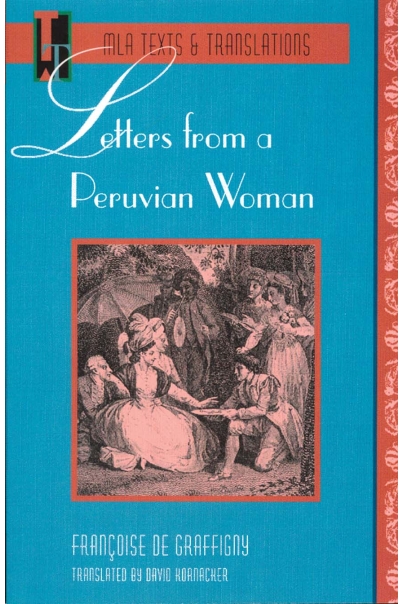
Letters from a Peruvian Woman
- Author: Françoise de Graffigny
- Translator: David Kornacker
- Pages: xxviii & 174 pp.
- Published: 1993
- ISBN: 9780873527781 (Paperback)

“This eighteenth-century novel turns the concept of ‘savage’ on its head in a scathing—and feminist—critique of French society.”
—Publisher’s Weekly
One of the most popular works of the eighteenth century, Letters from a Peruvian Woman appeared in more than 130 editions, reprints, and translations during the hundred years following its publication in 1747. In the novel the Inca princess Zilia is kidnapped by Spanish conquerors, captured by the French after a battle at sea, and taken to Europe. Graffigny’s brilliant novel offered a bold critique of French society, delivered one of the most vehement feminist protests in eighteenth-century literature, and announced—fourteen years before Rousseau’s Julie, or the New Eloise—the Romantic tradition in French literature. This edition is the first English translation in almost two hundred years.
Born in 1695, Françoise de Graffigny (née d’Happencourt) grew up in Lorraine. Married in 1712, she was the victim of frequent and violent physical abuse by her husband. She was granted a legal separation, but not before he had squandered much of her dowry. In 1738, Graffigny moved to Paris and began a writing career, during which she penned stories, children’s fables, plays (one of which, Cénie, was a smash hit in 1750), and Letters from a Peruvian Woman. She died in Paris in 1758.
“Long denied ‘classic status’ by the old pedagoguery, Graffigny’s only novel, excellently translated by David Kornacker, has apparently benefited from the ‘canon revision’ of the new.”
—Times Literary Supplement
“Translations [of Letters of Mistress Henley Published by Her Friend and Letters from a Peruvian Woman] have rescued these epistolary novels for an MLA series expected to make inroads in literature and women’s studies curriculum. They are aptly translated, echoing their 18th-century origins, and deserve to succeed in rectifying students’ notion of literature of the Enlightenment.”
—Library Journal