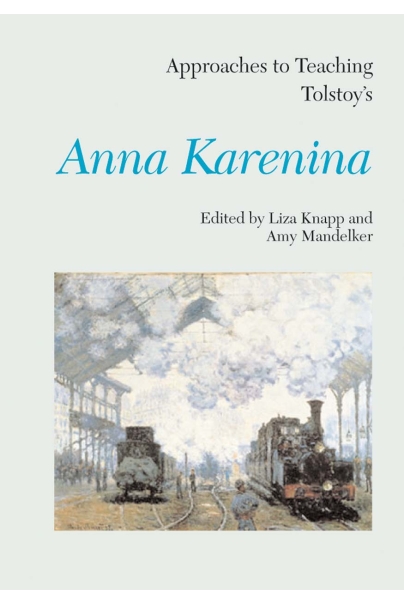
Approaches to Teaching Tolstoy’s Anna Karenina
- Editors: Liza Knapp, Amy Mandelker
- Pages: ix & 226 pp.
- Published: 2003
- ISBN: 9780873529051 (Paperback)
- ISBN: 9780873529044 (Hardcover)

“[A] wonderful resource for teachers and scholars which both reminds us of the rich history of Tolstoy criticism and also suggests the breadth of our field today.”
—Russian Review
Tolstoy’s Anna Karenina is probably the most often taught nineteenth-century Russian novel in the American academy. Teachers have found that including this virtuoso work of art on a syllabus reaps many rewards, especially in courses that connect texts thematically (e.g., Adultery in the Novel) or theoretically (e.g., Russian Literature into Film, Theory of Narrative). It also stirs up heated classroom discussion—on sex and sexuality, dysfunction in the family, gender roles, society’s hypocrisy and cruelty. But because of translation and transliteration problems, the peculiarity of Russian names and terms, the unfamiliarity of Russian geography and history, and the very size of the novel, teaching it presents challenges.
This volume, the seventy-eighth in the MLA’s Approaches to Teaching series, provides a comprehensive resource for dealing with these difficulties. The introduction contains a section on the complicated issue of names in Anna Karenina and another on the setting: time and space in the novel, Moscow versus Petersburg, the Russian country estate, travel, the railroad. Part 1, “Materials,” discusses and evaluates English translations and Russian editions of Anna Karenina and recommends works in the critical literature. In part 2, “Approaches,” twenty-two seasoned instructors of the novel describe their classroom experiences and suggest ways of introducing students to this powerful work; topics include ideas in Anna Karenina, agrarian issues, Tolstoy’s antiphilosophical philosophy, Tolstoy versus Dostoevsky, Anna’s dreams, and the reader’s moral education.
“The essays reflect an awareness of the latest research on the novel, and the range of topics and list of contributors are impressive. Those less familiar with Russian literature or with Tolstoy will find something new on virtually every page, but even Russian specialists will find inspiration from many of the essays.”
—Barry Scherr, Dartmouth College
“This book is to be very warmly welcomed. While covering some fairly familiar material and approaches in a form which will be accessible to undergraduates and the general reader, it also offers spirited and innovative discussions of key aspects of what is perhaps the most important of Russian novels.”
—Modern Language Review
“The editors of this volume have done a terrific job of gathering together some of the best names in the field and sharing with the readers their collective knowledge and expertise. . . . Materials from this volume are suitable for graduate seminars, thematically organized undergraduate courses, general surveys, or comparative literature courses.”
—Rocky Mountain Review
