Approaches to Teaching the Works of Ovid and the Ovidian Tradition
- Editors: Barbara Weiden Boyd, Cora Fox
- Pages: vii & 294 pp.
- Published: 2010
- ISBN: 9781603290630 (Paperback)
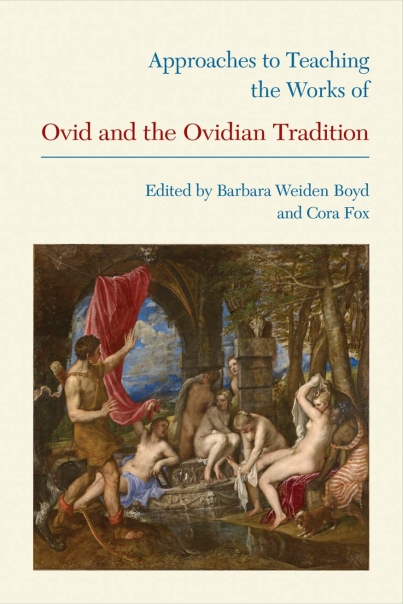

“[T]his intelligently edited group of essays will be of great use to anyone interested in the relevance of Ovid’s writings and their afterlives for present-day sensibilities.”
—The Classical Review
Ovid and his influence are studied in classrooms as various as his poetry, and this Approaches volume aims to help instructors in those diverse teaching environments. Part 1, “Materials,” is fittingly collaborative and features brief overviews designed to give nonspecialists background on the more challenging aspects of teaching Ovid. Contributors examine his life and legacy, religion, and relation to the visual arts as well as his afterlife in the Latin classroom, in various translations, and in the Ovide moralisé. The editors detail the contexts in which Ovid is taught, identify trends in teaching his work and the Ovidian tradition, and recommend editions and resources for classroom use.
The introduction to part 2, “Approaches,” considers Ovid’s relation to Vergil and the development of Ovid’s influence and reception, from the medieval and early modern period to the reinvigoration of Ovid studies in the twentieth century. In the four sections that follow, contributors provide practical ideas for classroom instruction, examine the political and moral discourses shaping Ovid and his legacy, explore how gender and the body are represented in Ovid and the Ovidian tradition, and look at various ways Ovid’s works have been used and transformed by writers as diverse as Dante, Cervantes, and Ransmayr.
Susan C. Anderson
William S. Anderson
Patrick Cheney
Raymond Cormier
Frederick A. De Armas
Jim Ellis
Nikolai Endres
Jamie C. Fumo
Judith P. Hallett
R. W. Hanning
Ronald W. Harris
Ralph Hexter
Samuel Huskey
Mary Jaeger
Phyllis Katz
Sean Keilen
Alison Keith
Peter E. Knox
Scott Maisano
Christopher M. McDonough
Matthew McGowan
Paul Allen Miller
Frank Palmeri
Wendy Chapman Peek
Lorina N. Quartarone
Bruce Redford
Madison U. Sowell
Goran V. Stanivukovic
M. L. Stapleton
Acknowledgments (ix)
Preface (1)
Editions Used in This Volume (3)
PART ONE: MATERIALS
Ovid’s Life and Legacy
Introduction (7)
Roman Religion and Ovid (13)
Ovide moralisé (18)
Speaking Pictures: Ovid and the Visual Arts (23)
Ovid’s Texts in the Classroom
Commentaries on Ovid (27)
Ovid in Premodern English Translation (31)
Ovid in Modern Translation (34)
Surveying Pedagogy and Practice: A Report on the MLA Survey (39)
PART TWO: APPROACHES
Introduction (49)
Ovid’s Classrooms
Caveat Lector: Learning to Read through Ovid (57)
Genre Transformed: The “Heroes” of Ovid’s Epic (64)
Approaches to Teaching Ovid’s Tristia (73)
From Ovid to Elvis: Teaching Mythology in the Classical Tradition (80)
Reading and Teaching Ovid’s Amores and Ars amatoria in a Conservative Christian Context (88)
Ovid and His Human Animals (95)
Teaching Medea to Freshmen: Ovid, Thematic Criticism, and General Education (102)
Political Ovid
Always Hopeless, Never Serious: Wit and Wordplay in Ovid’s Amores (109)
Transforming Exile: Teaching Ovid in Tomis (117)
Teaching the Really Minor Epic: Literature, Sexuality, and National Belonging in Thomas Edwards’s “Narcissus” (126)
Teaching the Ovidian Shakespeare and the Politics of Emotion (133)
Reforming Metamorphoses: The Epic in Translation as a “Major Work” of the English Renaissance (142)
Ovid’s Genial and Ingenious Story of King Midas (151)
Gendered and Embodied Ovid
Sex and Violence in Amores (161)
Ovid’s Thisbe and a Roman Woman Love Poet (170)
The Lay of the Land: The Rhetoric of Gender in Ovid’s “Perseid” (178)
Teaching Ovidian Sexualities in English Renaissance Literature (189)
Teaching Marlowe’s Translation of Amores (197)
Teaching Tiresias: Issues of Gender and Sexuality in Ovid and Beyond (204)
Metatextual Ovid
Metamorphoses Metamorphosed: Teaching the Ovidian Tradition (212)
Metamorphoses, Its Tradition, and the Work of Art (219)
Island Hopping: Ovid’s Ariadne and Her Texts (225)
The Case of Ovid in Dante (234)
Captured in Ekphrasis: Cervantes and Ovid (241)
Ovid and Ransmayr: Translating across Cultures and Times (250)
Notes on Contributors (257)
Contributors and Survey Participants (261)
Works Cited (263)
Index (289)
“This book is unusually helpful to the broad teaching community. It will be welcomed by classicists, teachers of literature in many languages, historians of gender, historians of visual arts, and teachers in many areas of general college education and secondary education.”
—Theresa Krier, Macalester College
