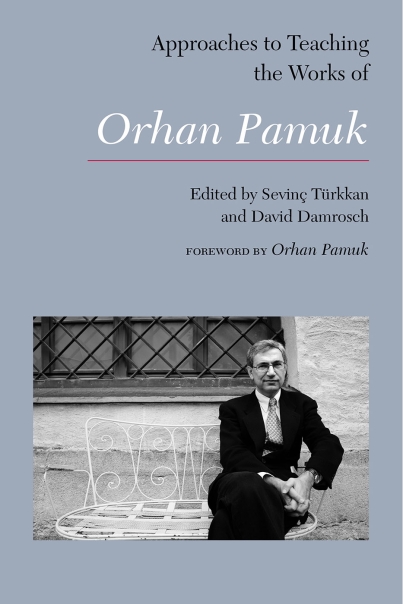
Approaches to Teaching the Works of Orhan Pamuk
Foreword by Orhan Pamuk
- Editors: Sevinç Türkkan, David Damrosch
- Pages: 247
- Published: 2017
- ISBN: 9781603293198 (Paperback)
- ISBN: 9781603293181 (Hardcover)

“This is a ‘handbook’ in its best sense, both for teaching Orhan Pamuk and for reflecting on critical methodology. This volume will be a significant contribution to literary scholarship and related fields.”
Winner of the Nobel Prize in Literature in 2006, Orhan Pamuk is Turkey’s preeminent novelist and an internationally recognized figure of letters. Influenced by both Turkish and European literature, his works interrogate problems of modernity and of East and West in the Turkish context and incorporate the Ottoman legacy linguistically and thematically. The stylistic and thematic aspects of his novels, his intriguing use of intertextual elements, and his characters’ metatextual commentaries make his work rewarding in courses on world literature and on the postmodern novel. Pamuk’s nonfiction writings extend his themes of memory, loss, personal and political histories, and the craft of the novel.
Part 1, “Materials,” provides biographical background and introduces instructors to translations and critical scholarship that will elucidate Pamuk’s works. In part 2, “Approaches,” essays cover topics that support teachers in a range of classrooms, including Pamuk’s use of the Turkish language, the political background to Pamuk’s novels, the politics of translation and aesthetics, and Pamuk’s works as world literature.
Hülya Adak
Barish Ali
Bernt Brendemoen
Gloria Fisk
Carolyn McCue Goffman
Erdag˘ Göknar
David Gramling
Didem Havliog˘lu
Darcy Irvin
Djelal Kadir
E. Khayyat
John Limon
Jennifer Malia
B. Venkat Mani
Bruce Robbins
Esra Mirze Santesso
Nhora Lucía Serrano
Delia Ungureanu
Yin Xing
Preface (ix)
Foreword: The Elephant in the Classroom (xi)
PART ONE: MATERIALS
The Author (3)
Fiction, Screenplay, and the Museum of Innocence (3)
Pamuk’s Nonfiction (8)
Interviews and Press (9)
Pamuk and His Translators (10)
Resources for Teachers (11)
PART TWO: APPROACHES
Introduction (15)
Historical and Cultural Contexts
Pamuk’s Use of the Turkish Language (26)
Coups, Violence, and Political Turmoil: Aesthetics and Politics in Pamuk’s Novels (36)
Pamuk and New Turkish Literature (46)
Pamuk, Translation, and the Transnational Context
The White Castle: Reception, Paratexts, and the Politics of Translation (55)
Teaching Snow as a Translation (66)
Pamuk’s Essays in Multicultural Classrooms in North America and the Middle East (76)
Teaching Pamuk beyond the East-West Divide
How to Read Pamuk? Naively and Sentimentally, Of Course (85)
Mapping Pamuk onto the World Literature Syllabus (94)
What Is World Literature? Teaching My Name Is Red as the Other Text (106)
Reading the End of Empire: Teaching Istanbul with Two Ottoman Memoirs (116)
The Discourse of the Other in Snow (126)
Teaching Pamuk in Dialogue with World Literature
The Transmission of Pamuk; or, The Sound of Silent House (135)
Unpacking Pamuk’s Library: A Print-Cultural Dialogue with World Literature (145)
Border Crossing with The Black Book: Overcoming Spatial, Cultural, and Linguistic Distances (155)
The World as Book: Teaching The New Life Intertextually with Dante, Borges, and Calvino (163)
Elective Asymmetries: Pamuk Teaching World Literature (173)
The Love Triangle in Snow (183)
Aesthetic Representations and Visual Studies
The Ekphrastic Detectives: Readers, Art, and Identity in My Name Is Red (192)
Illuminating My Name Is Red and The Museum of Innocence (202)
The Novel as Museum, the Museum as Novel: Teaching The Museum of Innocence (211)
Notes on Contributors (219)
Survey Participants (223)
Works Cited (225)
Index (243)
