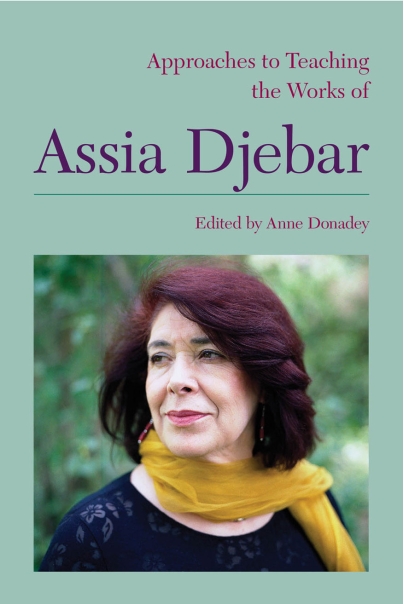
Approaches to Teaching the Works of Assia Djebar
- Editor: Anne Donadey
- Pages: x & 188 pp.
- Published: 2017
- ISBN: 9781603292962 (Paperback)
- ISBN: 9781603292955 (Hardcover)

“This constellation of essays provides numerous, insightful, culture-centered dialogical approaches to teaching her works. The essays are impressively adept at exploring the various interstitial spaces in Djebar’s works, where languages, genres and viewpoints intertwine, expanding the students’ horizons of thinking, bringing nuances to their perspectives, and challenging the ideas they often take for granted.”
—African Studies Review
A significant and prolific francophone writer and filmmaker, Assia Djebar is celebrated for her experimental, multilingual prose and her nuanced, imaginative representations of Algeria. From her first novel, La soif (The Mischief), to her final book, Nulle part dans la maison de mon père (“No Place in My Father’s House”), she offers a wealth of pedagogical and theoretical possibilities.
Part 1, “Materials,” presents valuable teaching resources, including biographical information, French- and English-language editions of Djebar’s writing, and secondary works. In part 2, “Approaches,” contributors address the issues of and controversy surrounding her oeuvre, drawing on a range of interdisciplinary approaches and classroom strategies. Topics in the volume include translation studies, Islamic feminism, colonial and postcolonial contexts, autobiographical writing, historiography, postmodern and avant-garde literary experimentation, and visual culture. Gayatri Chakravorty Spivak provides an afterword. This volume makes clear the political, intellectual, and artistic importance of Djebar.
Diya Abdo
Maria Bobroff
Carine Bourget
Maya Boutaghou
Valérie J. Budig-Markin
Thérèse De Raedt
Hanan Elsayed
Dominique D. Fisher
Martine Guyot-Bender
Christa Jones
Kathryn Lachman
Mildred Mortimer
Najat Rahman
Alison Rice
Annica Schjött Vonèche
Gayatri Chakravorty Spivak
Dana Strand
Vlatka Velčić
Contents (vii)
Preface (ix)
PART ONE: MATERIALS
Her Life (3)
Editions, Translations, and Secondary Sources (6)
PART TWO: APPROACHES
Introduction (11)
Historiographical Approaches
Finding One’s History: Beyond Chronology in L’amour, la fantasia (21)
“Attending to the Past, the Future Is Always around the Corner”: Narrative Intervention in Assia Djebar’s L’amour, la fantasia (29)
Seeds of Change: Assia Djebar’s Les enfants du nouveau monde / Children of the New World: A Novel of the Algerian War (37)
Early Islamic Historiography: The Background and Sources of Loin de Médine (44)
Interdisciplinary Approaches
Don’t Claim to “Speak for” Algerian Women: Reading Djebar across Disciplinary Borders (52)
Visual and Textual Interplay: Delacroix, Picasso, Djebar, Balzac, and Fromentin (59)
Using Print, Film, and News Media to Teach Assia Djebar’s Oran, langue morte (69)
Interdisciplinary Approaches to Teaching Documentary Genres in Assia Djebar’s La femme sans sépulture and La disparition de la langue française (76)
“Gender, Mystery, and Difference”: The Treatment of Myth in Assia Djebar’s La disparition de la langue française (83)
Teaching Assia Djebar in Dialogue
Teaching Assia Djebar’s Work in an Age of Fundamentalism (90)
Reading Assia Djebar in Dialogue (105)
Unraveling the Limits of Narrative and “The Blood of Writing”: Teaching Assia Djebar’s So Vast the Prison in Comparative Contexts (112)
Cultural and Linguistic Contexts
Teaching Assia Djebar, Islam, and Islamic Feminism in the Post-9/11 World (121)
Teaching Assia Djebar to Second- and Third-Year Students of French and Francophone Studies (130)
Writing in Bi-langue (138)
Tangled Tongues: Teasing Out Multiple Meanings in Translation (150)
How to Teach Assia Djebar: An Afterword (157)
Notes on Contributors (163)
Survey Participants (165)
Works Cited (167)
Index (185)
“Approaches to Teaching Assia Djebar is a timely volume both within and beyond Djebar studies, offering insightful direction for teachers and students alike of comparative literatures, littérature-monde, cultural translation, and linguistics more generally.”
—Beatrice Ivey, Modern Language Review
“The rich variety and specificity of pedagogical suggestions throughout will help instructors to increase students’ learning.”
—French Review
