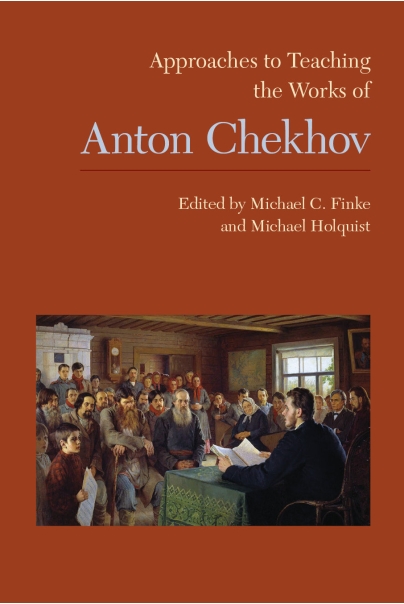
Approaches to Teaching the Works of Anton Chekhov
- Editors: Michael C. Finke, Michael Holquist
- Pages: viii & 233
- Published: 2016
- ISBN: 9781603292689 (Paperback)
- ISBN: 9781603292672 (Hardcover)

“This volume brings together masterful teachers of literature who share expertise in how to read Chekhov's work, gained over decades of working with undergraduates. A fascinating and instructive project which is both thought-provoking and pragmatic.”
—Angela Brintlinger, Ohio State University
Chekhov’s works are unflinching in the face of human frailty. With their emphasis on the dignity and value of individuals during unique moments, they help us better understand how to exist with others when we are fundamentally alone. Written in Russia at the end of the nineteenth century, when the country began to move fitfully toward industrialization and grappled with the influence of Western liberalism even as it remained an autocracy, Chekhov’s plays and stories continue to influence contemporary writers.
The essays in this volume provide classroom strategies for teaching Chekhov’s stories and plays, discuss how his medical training and practice related to his literary work, and compare Chekhov with writers both Russian and American. The volume also aims to help instructors with the daunting array of new editions in English, as well as with the ever-growing list of titles in visual media: filmed theater productions of his plays, adaptations of the plays and stories scripted for film, and amateur performances freely available online.
Thomas Adajian
Carol Apollonio
Brian James Baer
Lisa Siefker Bailey
Jane Costlow
Julie W. de Sherbinin
Stanton B. Garner, Jr.
John Griswold
Benjamin Knelman
Olga Levitan
John MacKay
Gary Saul Morson
Lyudmila Parts
Annamaria Pileggi
Cathy Popkin
Valleri J. Robinson
Rita Safariants
Gabriella Safran
Maia Solovieva
Dmitry Tartakovsky
Conevery Bolton Valencius
A Note on Transliteration, Citations, and Dates (vii)
Part One: Materials
Chekhov’s Biography: Outline, Useful Resources, and Notes on Biography as an Object of Study (4)
Chekhov in Translation (12)
Editions of Chekhov’s Works (16)
The Instructor’s Library (16)
Part Two: Approaches
Introduction: Teaching Chekhov, Chekhov Teaching: “A Boring Story” and Critical Thinking (23)
Approaches to Chekhov’s Prose
Chekhov and the Anglophone Short Story (34)
Reading Chekhov’s Short Fiction: The Invisible Language of Culture (41)
Teaching Chekhov in Translations (48)
A Tolstoyan Narratological Lesson: Teaching What Chekhov Learned (56)
Classroom Strategies: Writing and Performance
Chekhov in the Undergraduate Creative Writing Classroom (64)
Adapting Chekhov: A Primer for Dramaturgs (74)
A Performance-Based Approach to Play Analysis Using Anton Chekhov’s The Three Sisters (82)
Introducing Chekhov’s The Cherry Orchard with Method-Style Acting and Facebook-Style Reacting (91)
Teaching Chekhov in Film and Theater
Chekhov’s Seagull: Teaching Poetics through Stage History (98)
Chekhov’s Seagull in Postmodern Times: Boris Akunin and Tennessee Williams (106)
Stagescapes, Scenescapes: Uncle Vanya on Film (114)
Chekhov on the Screen: Lady with a Little Dog (1960) and Vanya on Forty-Second Street (1994) (123)
Cross-Curricular Approaches
History, Voice, Money, and Trees: “Rothschild’s Fiddle” and the Jews (141)
“A Talent for Humanity”: Teaching Chekhov and the Medical Humanities (151)
Reading the Environmental Chekhov (163)
Teaching Chekhov as Environmental History: Sakhalin Island and Cold Climates (171)
Beauty in “The Beauties”: Teaching Aesthetic Theory through a Chekhov Short Story (179)
Chekhov’s Art of the Prosaic: Great Ideas and Dramatic Events (187)
Appendix: Concordance of Translation Variants of Titles Mentioned in This Volume (197)
Notes on Contributors (203)
Survey Participants (207)
Works Cited (209)
Index of Works by Chekhov (227)
Index of Names (229)
