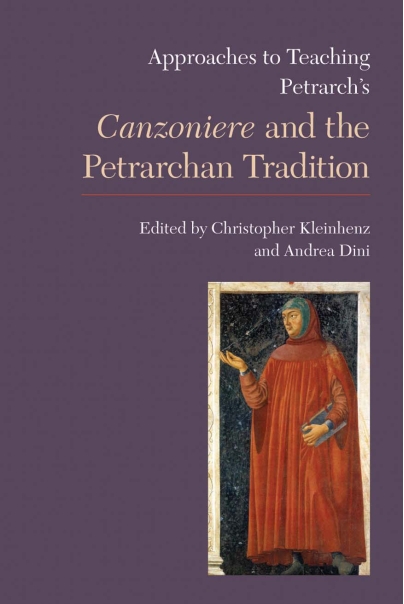
Approaches to Teaching Petrarch’s Canzoniere and the Petrarchan Tradition
- Editors: Christopher Kleinhenz, Andrea Dini
- Pages: xii & 300 pp.
- Published: 2014
- ISBN: 9781603291378 (Paperback)
- ISBN: 9781603291361 (Hardcover)

“[A]n excellent resource for any instructor who is serious about teaching Petrarch in such a way that students will fully appreciate him. . . . Those who are new to teaching Petrarch will find ample resources to aid in constructing the most effective syllabus possible, while veteran teachers with students who struggle to connect may discover new approaches to reinvigorate their courses.”
—Comitatus: A Journal of Medieval and Renaissance Studies
One of the most important authors of the Middle Ages, Petrarch occupies a complex position: historically, he is a medieval author, but, philosophically, he heralds humanism and the Renaissance. Teachers of Petrarch’s Canzoniere and his formative influence on the canon of Western European poetry face particular challenges. Petrarch’s poetic style brings together the classical tradition, Christianity, an exalted sense of poetic vocation, and an obsessive love for Laura during her life and after her death in ways that can seem at once very strange and—because of his style’s immense influence—very familiar to students. This volume aims to meet the varied needs of instructors, whether they teach Petrarch in Italian or in translation, in surveys or in specialized courses, by providing a wealth of pedagogical approaches to Petrarch and his legacy.
Part 1, “Materials,” reviews the extensive bibliography on Petrarch and Petrarchism, covering editions and translations of the Canzoniere, secondary works, and music and other audiovisual and electronic resources. Part 2, “Approaches,” opens with essays on teaching the Canzoniere and continues with essays on teaching the Petrarchan tradition. Some contributors use the design and structure of the Canzoniere as entryways into the work; others approach it through discussion of Petrarch’s literary influences and subject matter or through the context of medieval Christianity and culture. The essays on Petrarchism map the poet’s influence on the Italian lyric tradition as well as on other national literatures, including Spanish, French, English, and Russian.
Fabian Alfie
Fiora A. Bassanese
Aldo S. Bernardo
Theodore J. Cachey, Jr.
Tom Dolack
William J. Kennedy
Deborah Lesko Baker
Christopher Livanos
Massimo Lollini
Ilaria Marchesi
Simone Marchesi
Christopher Martin
Elizabeth H. D. Mazzocco
Leah Middlebrook
Elisabetta Properzi Nelsen
Tanya Pollard
Silvia Ross
Laurie Shepard
Michael Sherberg
Madison U. Sowell
Marc Vanscheeuwijck
Germaine Warkentin
Jobst Welge
Edoardo Zuccato
Preface
PART ONE: MATERIALS
Editions and Translations
Required and Recommended Readings for Undergraduates
The Instructor’s Library
Reference Works
Biographies and Background Works
Works on the Development of the Canzoniere
Collections of Essays
Essays
Petrarchism
Electronic and Audiovisual Resources
Texts and Studies
Audio Resources
Iconography
PART TWO: APPROACHES
Introduction: The Canzoniere and the Petrarchan Tradition in the Classroom
The Canzoniere’s Form: Design, Themes, Style
Approaches to the Design of Petrarch’s Canzoniere
Petrarch, Laura, and the Canzoniere
Petrarch’s Lyric Poetry: Prosody, Rhymes, Forms
Using a Concordance to Teach Petrarch’s Canzoniere
“Parole Estreme”: Canzoniere 126
The Canzoniere and the Life
The Life and Works as Journey
Love and Misogamy in the Age of Dante and Petrarch
Solitude and Inwardness: Approaching the Canzoniere through De vita solitaria and the Secretum
Petrarch and the Ethics of Writing and Reading
Teaching Petrarch’s Literary Influences
Petrarch’s Vernacular Poetry and the Latin Poetic Canon: The Poetics of Classical Philology
Echoes and Mirrors: Dante’s Shadow in Petrarch’s Canzoniere
Boccaccio and Petrarch
Teaching Petrarch through Music
“Another Petrarch”: Teaching Petrarch through Music
Promoting Student Understanding of Petrarch’s Canzoniere through Popular Music
Petrarch and the Italian Tradition
Petrarch’s Lyric Progeny
Petrarch’s Women
Tradition and Imitation in Petrarchan Poetics: The Song of the Nightingale
Petrarch and the Search for Antica Virtù
Teaching Petrarchism in the Context of Post-Risorgimento Poetry
Petrarch in a Comparative Context
On Teaching the Canzoniere to Students of Spanish
Exploring Petrarchan Subjectivity in the Early Modern French Lyric
English Petrarchism
Teaching Petrarch and Shakespeare
Petrarch in English after 1750
Russian Petrarchism
The Canzoniere in a Comparative Literature Curriculum
Notes on Contributors
Survey Respondents
Works Cited
Index
“A solid and much-needed volume. There is a nice balance between established scholars and younger ones, as well as between essays that range over Petrarch’s entire career and those that focus on individual themes or poems.”
—Jane Tylus, New York University
“I particularly recommend the book for medieval and early modern literature instructors fortunate enough to teach Petrarch’s challenging and rewarding text.”
—Studies in Medieval and Renaissance Teaching
