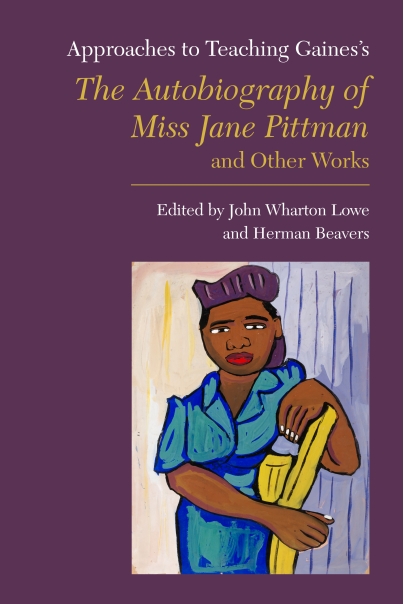
Approaches to Teaching Gaines’s The Autobiography of Miss Jane Pittman and Other Works
- Editors: John Wharton Lowe, Herman Beavers
- Pages: 280
- Published: 2019
- ISBN: 9781603294607 (Hardcover)
- ISBN: 9781603294218 (Paperback)

“This is an outstanding and much-needed collection of essays on teaching Gaines’s work.”
—Marcia Gaudet, University of Louisiana, Lafayette
The Autobiography of Miss Jane Pittman tells the story of a woman, a community, and the African American experience from the Civil War through Jim Crow to the civil rights movement. This narrative and Gaines’s other novels and short stories explore the life of blacks in the South, their religious traditions and folkways, and their struggles under oppression. The southern communities described are diverse: blacks, creoles of color, poor whites, and wealthy landowners.
Part 1 of this volume provides biographical information about Ernest Gaines and a discussion of critical and background studies of his narrative. The essays in part 2 will help teachers of African American literature, American literature, and southern literature convey to their students various aspects of Gaines’s work and the adaptations of it in relation to southern literature, history, music, folk culture, and vernaculars of English.
Acknowledgments (vii)
Preface (ix)
PART ONE: MATERIALS
Editions and Anthologies (3)
Courses and Contexts (4)
The Instructor’s Library (5)
PART TWO: APPROACHES
Introduction (11)
The Autobiography of Miss Jane Pittman
“On His Own Two Feet”: Teaching Gaines’s The Autobiography of Miss Jane Pittman through Racial History (18)
An Interdisciplinary Approach to the Gothic Heart of Gaines’s The Autobiography of Miss Jane Pittman (35)
Miss Jane’s South: Southern Literature, Intertextuality, and The Autobiography of Miss Jane Pittman (47)
Humor and Folk Culture in The Autobiography of Miss Jane Pittman (56)
Whose Story Is This? Teaching The Autobiography of Miss Jane Pittman, Novel to Film (66)
The Autobiography of Miss Jane Pittman in Relation to Other Works by Gaines
Media Adaptations and Gaines’s Novels (76)
Gaines and the Black Power and Black Arts Movements (83)
Other Novels
An International and Comparative Approach to Gaines’s Catherine Carmier: The Influence of Ivan Turgenev’s Fathers and Sons (92)
Of Love and Dust: Why Gaines’s “Funnest” Novel Had to End in Tragedy (103)
His Foot in a Door That Slavery Built: History, Symbol, and Resistance in Gaines’s Of Love and Dust (115)
Falling Down Is Getting Up: Shame, Redemption, and Collaborative Change in In My Father’s House (128)
Football and the Pastoral in A Gathering of Old Men (144)
Beyond the Weeds: Teaching the Significance of Cajuns in A Gathering of Old Men (155)
Who Done It? Gaines’s A Gathering of Old Men as a Parody of Richard Wright’s “The Man Who Was Almost a Man” (164)
A Lesson Before Dying and the Culture of Surveillance (178)
Teaching Criminal Law Issues in A Lesson Before Dying: “She Knew, As We All Knew, What the Outcome Would Be” (194)
Short Stories
The Car as a Vehicle for Teaching Gaines’s “A Long Day in November” (212)
“Blues Fallin’ Down Like Hail”: Reading “The Sky Is Gray” as a Blues Narrative (219)
“Three Men,” Queer Studies, and Pedagogy (231)
Notes on Contributors (241)
Survey Respondents (245)
Works Cited (247)
Index (263)
