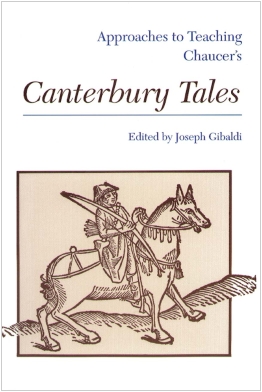
Approaches to Teaching Chaucer’s Canterbury Tales
Second Edition
- Editors: Peter W. Travis, Frank Grady
- Pages: xii & 243 pp.
- Published: 2014
- ISBN: 9781603291408 (Hardcover)
- ISBN: 9781603291415 (Paperback)


“Reading and teaching Chaucer is a daunting challenge. However, . . . this volume proves that the challenge is worth the effort.”
—Cercles
“[N]o Chaucer instructor should be without [this volume]. It abounds with new ideas for the classroom. . . . ”
—Studies in Medieval and Renaissance Teaching
Chaucer’s Canterbury Tales was the subject of the first volume in the Approaches to Teaching series, published in 1980. But in the past thirty years, Chaucer scholarship has evolved dramatically, teaching styles have changed, and new technologies have created extraordinary opportunities for studying Chaucer. This second edition of Approaches to Teaching Chaucer’s Canterbury Tales reflects the wide variety of contexts in which students encounter the poem and the diversity of perspectives and methods instructors bring to it. Perennial topics such as class, medieval marriage, genre, and tale order rub shoulders with considerations of violence, postcoloniality, masculinities, race, and food in the tales.
The first section, “Materials,” reviews available editions, scholarship, and audiovisual and electronic resources for studying The Canterbury Tales. In the second section, “Approaches,” thirty-six essays discuss strategies for teaching Chaucer’s language, for introducing theory in the classroom, for focusing on individual tales, and for using digital resources in the classroom. The multiplicity of approaches reflects the richness of Chaucer’s work and the continuing excitement of each new generation’s encounter with it.
Peter G. Beidler
Bethany Blankenship
Michael Calabrese
Jane Chance
Howell Chickering
Andrew Cole
Donna Crawford
Kara Crawford
Holly Crocker
Bryan P. Davis
Martha W. Driver
Robert Epstein
Patricia Clare Ingham
Alexander L. Kaufman
Leonard Michael Koff
Roger A. Ladd
Jacob Lewis
Emma Lipton
Kathryn L. Lynch
Becky McLaughlin
Robert J. Meyer-Lee
Alex Mueller
Florence Newman
Tison Pugh
William Quinn
Larry Scanlon
Nicole Nolan Sidhu
Deborah M. Sinnreich-Levi
Timothy L. Stinson
Lorraine Kochanske Stock
Jamie Taylor
David Wallace
Michelle R. Warren
Tara Williams
Susan Yager
Preface
PART ONE: MATERIALS
Editions
Middle English Editions
Translations
Anthologies
Recommended Reading for Undergraduates
Aids to Teaching
Web Sites
Video and Audio Materials
Electronic and Multimedia Resources
The Instructor’s Library
Background Studies
Reference Works
Critical Works
PART TWO: APPROACHES
Introduction: A Survey of Pedagogical Approaches to The Canterbury Tales
Chaucer’s Language
Teaching Chaucer’s Middle English
The Forms and Functions of Verse in The Canterbury Tales
Teaching the Prosody of The Canterbury Tales
Teaching Chaucer in Middle English: The Joy of Philology
Worrying about Words in The Canterbury Tales
Getting Chaucer’s Jokes
Individual Tales and Fragments
The Problem of Tale Order
Chaucer and the Middle Class; or, Why Look at Men of Law, Merchants, and Wives?
Professions in the General Prologue
Teaching Chaucer’s Obscene Comedy in Fragment 1
The Man of Law’s Tale as a Keystone to The Canterbury Tales
Beyond Kittredge: Teaching Marriage in The Canterbury Tales
The Clerk’s Tale and the Retraction: Generic Monstrosity in the Classroom
Students’ “Fredom” and the Franklin’s Tale
The Prioress’s Tale: Violence, Scholarly Debate, and the Classroom Encounter
Chaucer’s Boring Prose: Teaching the Melibee and the Parson’s Tale
Strategies for Teaching
How to Judge a Book by Its Cover
Chaucer’s The Canterbury Tales in the Undergraduate English Language Arts Curriculum
A First Year’s Experience of Teaching The Canterbury Tales
Teaching The Canterbury Tales to Non-Liberal-Arts Students
Chaucer and Race: Teaching The Canterbury Tales to the Diverse Folk of the Twenty-First-Century Classroom
Making the Tales More Tangible: Chaucer and Medieval Culture in Secondary Schools
Producing The Canterbury Tales
Theory in the Classroom
Reading Food in The Canterbury Tales
Teaching Chaucer’s Canterbury Tales with Queer Theory and Erotic Triangles
Chaucerian Translations: Postcolonial Approaches to The Canterbury Tales
Chaucer’s Cut
Performance and the Student Body
Hidden in Plain Sight: Teaching Masculinities in The Canterbury Tales
The Pardoner’s “Old Man”: Postmodern Theory and the Premodern Text
The Canterbury Tales in the Digital Age
Designing the Undergraduate “Hybrid” Chaucer Course
Public Chaucer: Multimedia Approaches to Teaching Chaucer’s Middle English Texts
Chaucer’s Pilgrims in Cyberspace
Translating The Canterbury Tales into Contemporary Media
Digitizing Chaucerian Debate
Afterword
Signature Pedagogies in Chaucer Studies
Notes on Contributors
Survey Respondents
Works Cited
Index
“A worthy and needed successor to the 1980 edition, this volume charts in comprehensive fashion the goals that Chaucerians now have when they teach The Canterbury Tales and the methods they have devised to achieve them.”
—Warren Ginsberg, Knight Professor of Humanities, University of Oregon
“The value of the volume is to be found in its attention to individual tales. . . . There is something for everyone in here.”
—The Medieval Review
“With the myriad of pedagogic possibilities offered by its many contributors, [this] volume is a valuable resource for instructors looking for inspiration on how to achieve [their] goals in a modern classroom.”
—Studies in the Age of Chaucer
“Each essay is succinct and straightforward in its discussion, and each offers any number of tips for engaging today’s students with a work that they may find increasingly foreign. . . .”
—Parergon